How to Know God Is Happy With You
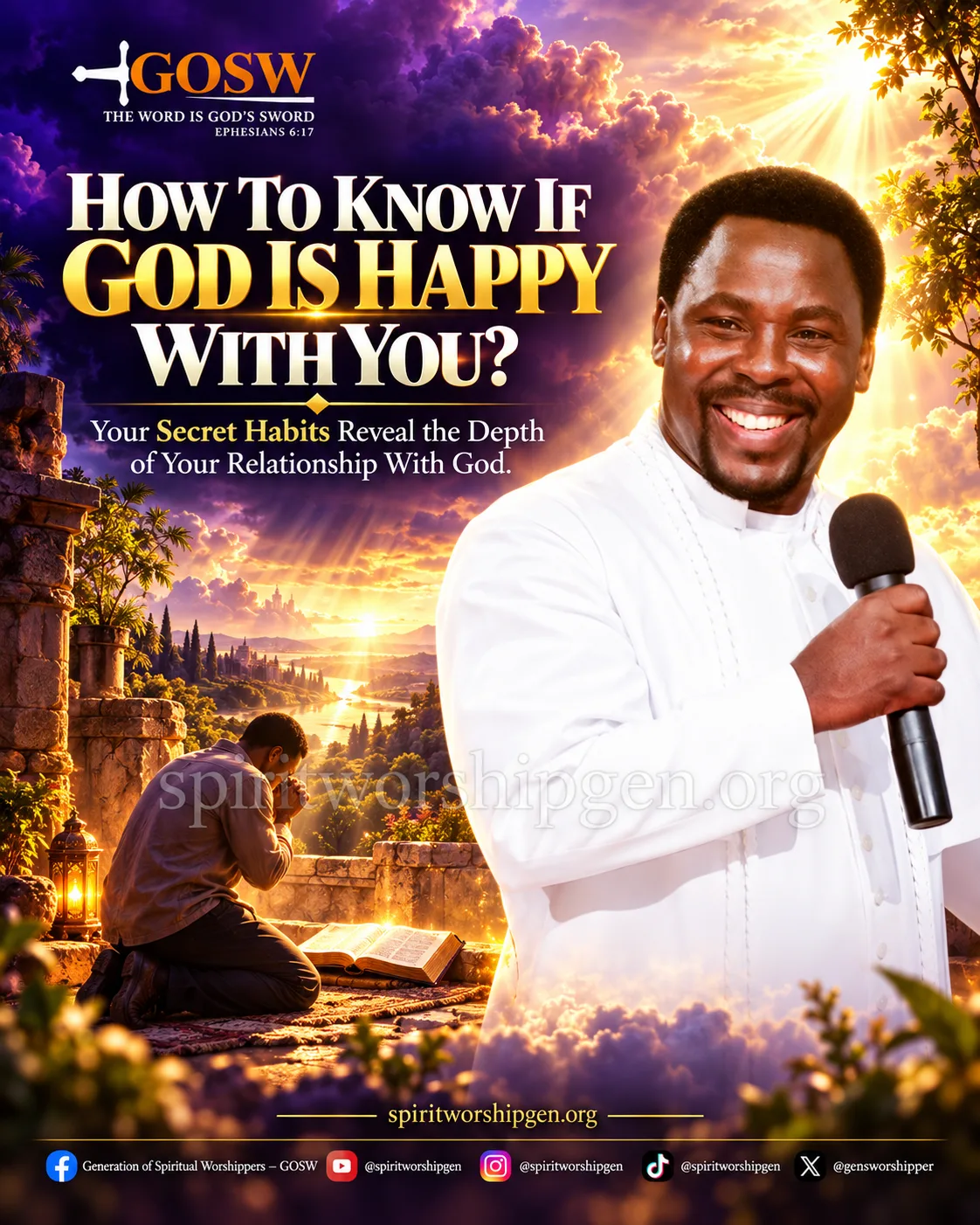
🌿 How to Know God Is Happy With You
“Take care of the depth of your relationship with God and He will take care of the breadth of your success.” — Prophet TB Joshua
How do you know God is happy with you? Not by how you feel on a good Sunday, not by who applauds you, and not by how loud your prayers sound. You start with something quieter and far more reliable: your faith habits. The consistency of those habits is how you read God’s state of mind toward you, and this teaching shows you how Cornelius, Daniel and Prophet TB Joshua all proved it.
On this page
- Start with your faith habits
- What God saw in Cornelius
- The things you do in secret please the Father most
- Nothing is too urgent to wait for God’s approval
- Prophet TB Joshua and the giving ministry
- He asked God before he built anything
- Depth first, then breadth
- Daniel: very precious to God
- Character, not gifts, made God happy
- Practical application: develop your faith habits
- Prayer
🌱 Start With Your Faith Habits
Everyone wants to know where they stand with God. Some look for a dramatic sign. Some wait for a prophet to tell them. Some measure it by whether their prayers were answered this week. But the God who sees everything has already built a simpler measure into the way a believer lives: what you do, again and again, when no one is asking you to do it.
A habit is a decision repeated until it becomes part of who you are. Faith habits are the repeated decisions that tie your daily life to God: prayer, the Word, giving, obedience, thanksgiving, asking before you act. A single burst of devotion tells God very little. Consistency tells Him everything. It says that you did not come to Him because you were desperate this month. You came because He is the centre of your life.
That is why the state of your habits is a mirror. When your faith habits are steady, you can be confident that your relationship with God is steady too. When they are irregular, switching on in a crisis and switching off in comfort, you are looking at a relationship that depends on your situation, not on your Father. If you want to understand the weight Prophet TB Joshua placed on this, read Great Men Simply Have Great Habits?, and see the three habits laid out in The 3 Daily Habits of a True Christian.
“What you do in secret is what will answer you in the open.” — Prophet TB Joshua
Hold on to that sentence. The whole teaching grows from it.
🕊️ What God Saw in Cornelius
Cornelius was a Roman army officer, a Gentile with no temple, no priesthood and no covenant history to lean on. Yet heaven noticed him. Look at what Scripture says about his life before the angel ever appeared:
“He was a devout, God-fearing man, as was everyone in his household. He gave generously to the poor and prayed regularly to God.” — Acts 10:2 (NLT)
Two habits, and both are named: he gave generously, and he prayed regularly. Then the angel arrived with this message:
“Your prayers and gifts to the poor have been received by God as an offering!” — Acts 10:4 (NLT)
Read that again slowly. His giving and his praying did not just happen and disappear. They fed his relationship with God until that relationship itself became an offering to the Almighty. God did not wait for Cornelius to preach a sermon, found a ministry or perform a miracle. God looked at the consistency of two quiet habits and responded with an angel, a visit from an apostle and the outpouring of the Holy Spirit on his whole household.
This is the first answer to the question. God is happy with a person whose habits He can count on. The same Cornelius is examined from the angle of tongues and the Spirit in To Pray in the Spirit is NOT to Speak in Tongues at Your Own Will, and his angelic visit is placed alongside other heavenly visitations in Angels: Messengers of God and Their Divine Assignments.
Notice also what is missing from the account. Cornelius had no title. Nobody was announcing his name from a platform. God had been watching a man whose life was already organised around Him, and it was the consistency that made the angel’s visit possible.
🤫 The Things You Do in Secret Please the Father Most
If you want to know what pleases the Father most about you, do not look at what the public sees. Look at what only He sees.
“But when you pray, go away by yourself, shut the door behind you, and pray to your Father in private. Then your Father, who sees everything, will reward you.” — Matthew 6:6 (NLT)
God pays careful attention to the consistency of what you do in secret. Anyone can give when there is a camera, pray when there is a crowd or quote Scripture when there is an audience. The real you is the one who shows up at 5 a.m. in a quiet room, who gives without a receipt, who forgives without telling the story and who obeys when nobody will ever check. Jesus said the same about giving:
“But when you give to someone in need, don’t let your left hand know what your right hand is doing. Give your gifts in private, and your Father, who sees everything, will reward you.” — Matthew 6:3-4 (NLT)
The pattern is the same each time: private faithfulness, public reward. This is not because God needs your secrets as a technique. It is because the secret place is the only place where your devotion is not mixed with anyone else’s opinion. What you do there is purely between you and Him. If you want to test yourself honestly, ask the question from What Do You Do in Your Secret Place?.
Enoch is the quiet proof that a life of private fellowship is what pleases God:
“It was by faith that Enoch was taken up to heaven without dying… For before he was taken up, he was known as a person who pleased God.” — Hebrews 11:5 (NLT)
Enoch’s resume was not a list of miracles. It was a reputation in heaven for being someone who pleased God, built over years of walking with Him.
🧭 Nothing Is Too Urgent to Wait for God’s Approval
The men and women God is happy with have one thing in common: they put God first in everything they do. They do not make their own plans and then ask for a blessing at the end. They bring the plan to Him before it begins. For them, nothing is too urgent to wait for God’s approval.
Apostle Paul is a clear example. He had a burning desire to preach, and Asia needed the gospel. A man driven by self-will would have gone anyway. But Scripture says:
“Next Paul and Silas traveled through the area of Phrygia and Galatia, because the Holy Spirit had prevented them from preaching the word in the province of Asia at that time.” — Acts 16:6 (NLT)
Paul did not push through the closed door. He could sense the resistance of the Holy Spirit and he respected it, even though what he wanted to do was good. How sensitive do you have to be to God’s position to stop a good work because the Spirit says no? This is the kind of sensitivity that grows only where there is a long history of listening. You can see how this played out for Paul in How to Know When a Thought Is From God, and how God directs the willing even through the night in Why Your Spiritual Condition Before Bed Shapes What Happens in Your Sleep.
Men like Paul stay sensitive to God even in the smallest things. Nothing in their lives is left unexamined. Every plan, every trip, every decision is placed under divine examination in the light of God’s Word. That is what it means to live with God first. And it is also why God can trust them with a great deal. If you want to see how a believer can build this habit in practical daily terms, read How Often Do You Involve God in Your Daily Plans?
Ask yourself honestly: is there an area of your life, a decision, a business step, a relationship, a purchase, that you have declared too urgent to wait for Him? Whatever you have stopped consulting Him about is probably the area where you have stopped feeling His pleasure.
🤲 Prophet TB Joshua and the Giving Ministry
Prophet TB Joshua gave regularly to the needy. Like he famously said, the Synagogue Church started from the giving ministry. Before the large crowds, before the television station and before the international crusades, there was giving. His love and focus were on people, and that was why God used him to build people instead of branches.
“What we give attracts people but the way and manner we give attracts God.” — Prophet TB Joshua
Look at how closely that mirrors Cornelius. Cornelius gave to the poor and prayed regularly, and God received it as an offering. TB Joshua started with giving, and God built a global ministry on top of that foundation. In both cases, giving was not an event. It was a habit that preceded the platform. You can read more about this side of his life in Giving Willingly and Freely: The Example of Prophet TB Joshua.
Notice what this means for you. If you are waiting to give until you have more, you are waiting for something God never required. He measures the consistency of the gift and the heart behind it, not the size of your bank balance.
🏛️ He Asked God Before He Built Anything
There is another story that shows what it looks like to wait for God’s approval in a big decision.
When Prophet TB Joshua began placing branches of the Synagogue Church Of All Nations in other countries, it was because of demands from lovers and partners of the ministry. He did not respond by outrightly putting up physical structures. He got a place for people to gather and watch Emmanuel TV, and he kept it that way for a few years while he asked God for His opinion and approval.
What came out of that waiting was clarity. He discerned that God’s will for him was to focus on building people, not physical branches. So the only branches that were maintained were SCOAN Ghana, SCOAN Thessalonica (now renamed CCOAN Thessalonica under Wiseman Harry Ministries) and the local church in his hometown, SCOAN Akure. He closed down SCOAN UK, SCOAN Cape Town and SCOAN Athens, Greece when he noticed practices that did not align with God’s standard for his ministries.
Think about what that cost. Closing a branch means giving up visible growth, numbers and influence. A man who measured success by how much he could build would have kept them all. But his aim was something else: he wanted to ensure God remained happy with him. For him, the approval of God was not a bonus that came after the work. It was the thing the work had to pass through first.
The ministry’s approach to people over buildings is a pattern the Lord Himself followed, as shown in When the Devil Beats His Drum in the Church, where Jesus is described as building the broken and not a brand.
And look at the result. As a reward for his obedience, God directed millions of people from all the nations of the earth to the headquarters church to worship there. God ensured that TB Joshua and the SCOAN enjoyed the privilege of being the centre of attraction, because nowhere else in the world could you see the same scale of miracles, signs and wonders, with apostolic gifts of prophecy, healing, deliverance and Spirit-filled teaching. His crusades filled entire stadiums with citizens of the host country, a black African minister standing before a sea of people from other nations. And in the middle of that crowd, he would often be heard saying:
“I am not the healer but I know the healer, His name is Jesus Christ.” — Prophet TB Joshua
The man who closed branches to protect his standing with God was the man God filled stadiums for. That is how God treats a person He is happy with.
🌊 Depth First, Then Breadth
God was happy with this man, so He allowed him to enjoy a kind of monopoly, for lack of a better word, as he moved in God’s extraordinary grace and abilities, the likes of which we read about with Moses in the Bible. Where was the secret? TB Joshua told us himself:
“I took care of the depth of my relationship with God and He took care of the breadth of my success.” — Prophet TB Joshua
Two words hold the whole teaching: depth and breadth.
Depth is what you do in secret. It is the prayer nobody hears, the Word nobody sees you reading, the giving nobody records, the obedience nobody checks. It goes down, and it is yours to take care of.
Breadth is how far your life spreads: your influence, your provision, your impact, your doors opening and your name carrying weight. It goes outward, and it is not yours to manufacture. It is what God does.
Here is what it means for you. If you want to know that God is happy with you, you will see the reflection of that happiness in the breadth of your success. Breadth is the evidence. Depth is the work. You do not hunt for the evidence. You do the work, and God supplies the evidence. When someone tries to build breadth without depth, they end up with something wide and shallow, which can be knocked over by the first strong wind. When someone builds depth first, God takes care of the width.
Moses is the pattern. God said He spoke to Moses face to face, plainly and not in riddles, and that Moses was entrusted with His entire house (Numbers 12:6-8). God defended the quality of the relationship, not the list of miracles. You can see this unpacked in Who Are You to God?, which carries the same depth and breadth principle.
“True humility means total dependence on God for everything.” — Prophet TB Joshua
When you depend on God for the breadth, you stop straining for it. That is a freedom most believers never taste.
👑 Daniel: Very Precious to God
Daniel took care of the depth of his prayer and devotional habit in the land of Babylon, and God was happy with him. How do we know? Because of what the angels kept saying. In Daniel 10, an angel was sent to him, and in the same conversation, he used almost the same words twice:
“Daniel, you are very precious to God, so listen carefully to what I have to say to you.” — Daniel 10:11 (NLT)
“Don’t be afraid,” he said, “for you are very precious to God. Peace! Be encouraged! Be strong!” — Daniel 10:19 (NLT)
Twice in one conversation, verse 11 and verse 19. You can clearly infer that God specifically instructed His messengers to tell Daniel that. A man who is precious to God is a man God is happy with. Think about how rare it is for heaven to send a sentence like that on purpose.
And the evidence of God’s happiness was seen in the breadth of Daniel’s success in Babylon. He rose under several kings in a foreign empire, in a culture that tried to remove his God from him. Daniel did not have the breadth because he was clever. He had it because of the depth: three times a day on his knees, whatever the king ordered (Daniel 6:10). You can see how Daniel’s private devotion compares with the other heroes in How Wholehearted Obedience Makes You Someone God Is Proud Of.
The same is true of Joseph, Abraham, David, Moses, Paul and many others. Joseph’s breadth in Egypt followed the depth of his integrity in Potiphar’s house and prison. Abraham was called a friend of God, which you can explore in What Does It Take to Be a Friend of God?. Each of them had a private life with God long before anyone saw their public life.
🔥 Character, Not Gifts, Made God Happy
Make no mistake. It was not their spiritual gifts that brought them great success. It was their character, their fruits, developed in the dark, that made God happy with them.
Gifts can impress people. Character is what pleases God. Prophet TB Joshua said the same thing in plain terms:
“In order to maintain God’s gift, we need God’s character.” — Prophet TB Joshua
This is a hard truth for a generation that measures spiritual people by what they can do on a platform. God measures by who you are in the dark, because that is where character gets formed. There are no shortcuts. If you want to read how God weighs the two, spend time on Why God Values Your Character More Than Your Spiritual Gifts.
Daniel gives us one of the clearest examples. When he was brought in to interpret Nebuchadnezzar’s dream, he did not step forward as a man with a special talent. He first and foremost acknowledged his God publicly before the king. He made it plain that he could not do this without God’s help, and he never exalted himself above the other wise men who could not interpret the dream.
“Daniel replied, ‘There are no wise men, enchanters, magicians, or fortune-tellers who can reveal the king’s secret. But there is a God in heaven who reveals secrets, and he has shown King Nebuchadnezzar what will happen in the future. Now I will tell you your dream and the visions you saw as you lay on your bed.’” — Daniel 2:27-28 (NLT)
Look at the humility in those words. He had the greatest gift in the room, and the first thing he did was point away from himself. Now put that beside the words of Prophet TB Joshua: “I am not the healer but I know the healer, His name is Jesus Christ.” The same spirit is speaking in both. They decreased themselves and increased God. At the biggest stage of their lives, they put their God forward.
That is what God is happy with. Not a man who uses a gift to be seen, but a man who uses a gift to make God seen. This is the theme of Humility: The Key to Higher Realms in God and of The Treasures of God Are for the Selfless.
Depth and breadth side by side
| Depth (your part) | Breadth (God’s part) | |
|---|---|---|
| Where it happens | In secret, before God alone | In the open, before others |
| What it looks like | Prayer, the Word, giving, obedience, humility | Influence, provision, open doors, lasting fruit |
| Who controls it | You, through daily choice | God, in His time |
| Biblical picture | Cornelius’s giving and praying (Acts 10:2) | The angel, the apostle and the Spirit poured out (Acts 10:4, 44) |
| Daniel’s example | Kneeling in prayer three times a day (Daniel 6:10) | Promoted in Babylon under several kings |
| TB Joshua’s example | Giving, prayer and waiting for God’s approval | Nations coming to the church and stadiums filled |
| What it proves | Your faith habits are real | God is happy with you |
✅ Practical Application: Develop Your Faith Habits
Are you developing your faith habits? You need humility and you need consistency. That is what will make God happy to start taking care of the breadth of your success. Here is how to begin.
- Choose your core habits and name them. Pick the few you will not break: a fixed time of prayer, daily Scripture, regular giving and an evening of thanksgiving. Write them down. A habit you have not named is a habit you cannot keep.
- Do one thing in secret every day. Give without being seen, pray in the closet, fast without announcing it, serve without a photo. The Father who sees everything is paying attention to this more than to anything public.
- Give regularly, not occasionally. Cornelius and TB Joshua both show that giving is a lifestyle, not a reaction to a need. Set an amount and a rhythm, and let it become part of your normal week.
- Bring every plan to God before it starts. Before you commit to a trip, a purchase, a partnership or a ministry step, ask Him first and wait for His response. Be willing, like Paul, to stop when the Spirit says no.
- Close the doors that do not meet God’s standard. TB Joshua closed branches that moved away from God’s standard. What have you been maintaining because of what it gives you, even though you know God is not pleased with it?
- Stop measuring yourself by gifts. Ask who you are when nobody is clapping. Character is what carries whatever God gives you.
- Acknowledge God publicly and put Him forward. Like Daniel before Nebuchadnezzar, give God the credit every time you are praised. Do not take what belongs to Him.
- Read your breadth correctly. When you see open doors, favour and fruit that you did not strain for, receive it as God’s report on your depth. And if the breadth seems slow, do not panic. Return to the depth and stay faithful, because He is not late.
The question is not “Is God happy with me?” as if the answer were a mystery. The question is “What do my habits say?” Your habits are already giving the answer.
🙏 Prayer
Father, I thank You for seeing me in secret. Forgive me for every habit I dropped when no one was watching. Teach me to take care of the depth of my relationship with You, and I trust You to take care of the breadth of my life. Make my prayer, my giving and my obedience an offering that rises before You like Cornelius’s. Keep me sensitive to Your Spirit in the smallest things, so that nothing is too urgent to wait for Your approval. Clothe me with the humility of Daniel, so that at every stage, I put You forward and not myself. Let me be someone You call precious. In Jesus’ name, Amen.
Good Morning 🌄 and PROSPER ✨ today!
Let this blog stir your spirit. Share it with someone who needs to hear this today, and continue your walk with God in deeper intimacy at www.spiritworshipgen.org.
Please like, follow and subscribe to our social media channels:
Facebook: Generation of Spiritual Worshippers - GOSW
YouTube: @spiritworshipgen
X (Former Twitter): @gensworshipper
Instagram: @spiritworshipgen
TikTok: @spiritworshipgen
Related Teachings





References
🌿 How to Know God Is Happy With You
🌿 GOSW: How to Know God Is Happy With You
Published by SpiritWorshipGen – A Generation of Spiritual Worshippers
Comments
This discussion is closed for new comments.