How Wholehearted Obedience Makes You Someone God Is Proud Of

🌿 God Wants to Be Proud of You
“Have you noticed my servant Job? He is the finest man in all the earth. He is blameless — a man of complete integrity. He fears God and stays away from evil.” — Job 1:8 (NLT)
That is God speaking. Not a preacher describing Job to impress a congregation, but God Himself, boasting about a man to Satan in the full hearing of heaven’s own courtroom. Somewhere right now, God is either boasting about you the same way, or grieving over you the way He grieved over Saul. The difference between those two outcomes was never talent, timing, or how eloquently someone speaks in church. It came down to one thing: what a person does the moment they are corrected.
On this page
- Samuel’s all-night cry over Saul
- A conscious sinner always has an excuse
- The finest man in all the earth: Job’s complete integrity
- A man after God’s own heart: David’s total loyalty
- Very precious to God: Daniel’s devotion under pressure
- A friend of God: Abraham’s uncompromising trust
- More humble than anyone on earth: Moses
- The idols that silence God’s verdict over your life
- How to live in tune with God
- Prayer
🐑 Samuel’s All-Night Cry Over Saul
“I am sorry that I ever made Saul king, for he has not been loyal to me and has refused to obey my command.” Samuel was so deeply moved when he heard this that he cried out to the Lord all night. — 1 Samuel 15:10–11 (NLT)
That is not a light sentence. God did not send Samuel a memo. He sent him grief, and Samuel carried that grief so heavily that he lost an entire night of sleep pleading with God over a man he himself had anointed. Before Samuel ever confronted Saul, he had already agonized before God on Saul’s behalf. That is what it looks like when a servant of God takes the weight of another person’s disobedience seriously.
Now watch what happened when morning came. “Well, the Lord bless you,” Saul said cheerfully. “I have carried out the Lord’s command!” (1 Samuel 15:13). Saul had no idea that the man standing in front of him had just spent the whole night weeping over him. He greeted Samuel like a man expecting applause, completely unaware that heaven was already grieving his choices.
“Correction makes future possible” — Prophet TB Joshua
“Whatever your challenges are as a Christian, they are a way of correction. The more the correction, the more the greatness.” — Prophet TB Joshua
Saul never understood correction as an invitation to greatness. He understood it as an accusation to defend against. That single misunderstanding is why the crown God gave him became the crown God tore from his family. Correction was never sent to embarrass Saul. It was sent to save him, and he treated it as an inconvenience.
😔 A Conscious Sinner Always Has an Excuse
Samuel confronted Saul directly, asking why he had spared what God commanded him to destroy. Saul’s answer is worth sitting with: “But I did obey the Lord” (1 Samuel 15:20). He said this while the bleating of sheep and the lowing of cattle he had disobediently kept alive were audible in the background. The evidence of his disobedience was making noise, and he still insisted he had obeyed.
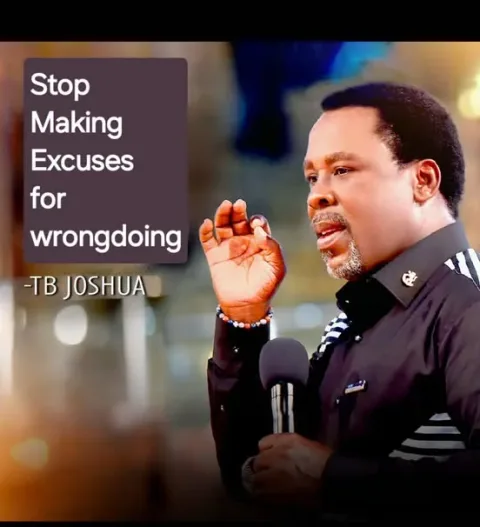
“An excuse is a reason, whether genuine or fake, which we give to explain or to defend our wrongdoing.” — Prophet TB Joshua
Notice that TB Joshua does not say an excuse is always a lie. Sometimes the reason given is technically true. Saul really did spare the best animals “to sacrifice to the Lord” (1 Samuel 15:21). The problem was never whether the excuse had some truth in it. The problem was that it was offered to defend disobedience instead of to confess it.
This pattern did not begin with Saul. It began in a garden. When God asked Adam, “Have you eaten from the tree whose fruit I commanded you not to eat?” Adam answered, “It was the woman you gave me who gave me the fruit, and I ate it.” When God turned to Eve and asked, “What have you done?” she replied, “The serpent deceived me, that’s why I ate it” (Genesis 3:11–13). Neither one said “I sinned.” Both pointed somewhere else.
A conscious sinner is one who makes excuses for their sin.
Compare that instinct to David’s, after Nathan the prophet confronted him over Bathsheba and Uriah. David did not say “the temptation was too strong” or “I was under pressure as king.” He said: “Have mercy on me, O God, because of your unfailing love. Because of your great compassion, blot out the stain of my sins… For I recognize my rebellion; it haunts me day and night” (Psalm 51:1,3). No deflection. No pointing to Bathsheba, to circumstance, or to the burden of the throne. Just ownership.
That is the fork in the road every believer eventually stands at. Correction arrives, and in that moment you either defend yourself or you break before God. There is no third option that keeps you standing in both places at once.
🌾 The Finest Man in All the Earth: Job’s Complete Integrity
Return to where this post began. God did not simply say Job was a good man. He used the outer edges of language to describe him: “finest,” “blameless,” “complete integrity” (Job 1:8). These are not the words of measured approval. They are the words of a Father who cannot stop talking about His son.
What makes this even more remarkable is when it was said. God said this to Satan, before any of Job’s suffering had begun, based purely on the private, unwatched life Job had already been living. Nobody had to test Job first for God to be sure of him. God already knew, because Job’s integrity was not a performance for an audience. It was who he was when no one but God was watching.
“God’s power cannot work in your heart unless your will is obedient to God’s will.” — Prophet TB Joshua
Job’s obedience was not partial. It was not obedience with exceptions carved out for convenience. That is precisely why, when everything was later stripped from him, wealth, children, health, he still had something left standing that none of it could touch: a will already surrendered to God long before the trial came. You cannot manufacture that kind of integrity in a crisis. You can only discover whether it was already there.
👑 A Man After God’s Own Heart: David’s Total Loyalty
God described David in a way He never described anyone else in the Old Testament: “I have found David… a man after my own heart, who will do everything I want him to do” (1 Samuel 13:14; Acts 13:22). Not the most talented man in Israel. Not the most impressive to look at, Samuel himself had initially overlooked him in favor of his more striking brothers (1 Samuel 16:6–7). What God found in David was a heart wired to move toward Him, even after failure.
This is the same David who sinned with Bathsheba, who arranged Uriah’s death, who tried at first to cover his own tracks. God’s description of David was not a claim that David never sinned. It was a claim about what David did the instant he was confronted. He broke. He repented. He did not defend himself the way Saul did. That single difference, not sinlessness, is what separated the man God tore the kingdom from and the man God built an everlasting throne through.
Our loyalty to God is meant to be wholehearted, exactly as commanded in Deuteronomy 6:5: “You must love the Lord your God with all your heart, all your soul, and all your strength.” Not most of your heart. Not your heart when it is convenient. All of it. David’s failures were real, but his loyalty, his default posture toward God, was never divided the way Saul’s was.
💎 Very Precious to God: Daniel’s Devotion Under Pressure
While Daniel was in the middle of prayer and fasting, mourning over Israel’s condition and pleading before God (Daniel 9:1–19), the angel Gabriel appeared to him mid-prayer with these words: “And now I am here to tell you what it was, for you are very precious to God” (Daniel 9:23). Some translations render it “greatly beloved.” Either way, God interrupted the natural order to send an angel just to tell one man how precious he was to Him.
Think about what earned that kind of attention. Daniel was not in a public gathering when this happened. He was alone, in prayer, confessing sin on behalf of a nation, with nothing to gain from anyone watching. This is the same Daniel who, years earlier and years later, “knelt down as usual in his upstairs room… three times a day, just as he had always done” (Daniel 6:10), even after a law was signed specifically to trap him in the act. His devotion did not change based on the political climate. It was consistent whether it was safe or dangerous, watched or unwatched.
That is what “very precious to God” actually costs. Not a moment of impressive performance, but years of unglamorous, repeated faithfulness that nobody had to remind him to keep.
🤝 A Friend of God: Abraham’s Uncompromising Trust
Scripture gives Abraham a title given to no one else quite the same way: “friend of God” (James 2:23; Isaiah 41:8; 2 Chronicles 20:7). Friendship implies closeness, trust that runs in both directions, a relationship not built on formality but on knowing and being known.
That friendship was tested at its most painful point when God asked Abraham to offer his only son, Isaac, the son of the promise, as a sacrifice (Genesis 22:2). Abraham did not negotiate. He did not stall. Scripture says he “got up early the next morning” to obey (Genesis 22:3), the same early-morning urgency Samuel had shown when he went looking for Saul, except this time in obedience rather than in grief. God was not looking to see whether Abraham would actually lose Isaac. He was looking to see whether anything, even the promise itself, stood higher in Abraham’s heart than God did. Nothing did.
That is what makes someone a friend of God rather than merely a servant of God. A servant obeys because he must. A friend obeys because nothing else in his heart competes for first place.
🧎 More Humble Than Anyone on Earth: Moses
God described Moses with a superlative given to no other man in Scripture: “Moses was very humble — more humble than any other person on earth” (Numbers 12:3). This was written about a man who had led an entire nation out of slavery, confronted the most powerful ruler on earth, and spoken with God face to face like a friend (Exodus 33:11). By every earthly measure, Moses had every reason to be proud. God’s Spirit chose instead to record his humility as the defining trait worth preserving for every generation after him.
God used the extremes of adjectives to describe those He was proud of: the finest man, complete integrity, very precious, more humble than anyone on earth, a friend. Every one of these descriptions was earned in private, in the unglamorous space between visible achievements, long before anyone else noticed.
🕊️ The Idols That Silence God’s Verdict Over Your Life
So how would God describe you right now, if He were speaking about you the way He spoke about Job? Are you wholeheartedly loyal to Him? Do you love Him with everything, or has something quietly taken a seat on the throne of your heart that only God should occupy?
“Son of man, these leaders have set up idols in their hearts. They have embraced things that make them fall into sin. Why should I let them ask me anything?” — Ezekiel 14:3 (NLT)
Notice the consequence. It is not simply that idols in the heart offend God. It is that they close the door to hearing His verdict about you altogether. As long as an idol sits enthroned in a heart, God will not even entertain that heart’s questions, let alone volunteer His opinion of it. That is a sobering thought. Many believers never get to hear what God thinks of them, not because God is silent by nature, but because an idol they have never confronted is standing in the way.
Contrast that with Cornelius, a Roman centurion described plainly as “a devout, God-fearing man” (Acts 10:2). Because of his sincerity, God sent an angel directly to him with these words: “Your prayers and gifts to the poor have been received by God as an offering!” (Acts 10:4). Cornelius did not have the Law, the temple, or the covenant history Israel had. What he had was an undivided heart toward God, and that was enough for heaven to take notice and respond.
God cannot be deceived. He always looks at the heart, never at the performance staged for others to see.
| Excuse-Maker’s Heart | God-Fearing Heart | |
|---|---|---|
| When corrected | Defends, deflects, blames another | Breaks, confesses, owns it immediately |
| Model | Adam, Eve, Saul | David, Job, Cornelius |
| What God hears | Justification | Repentance |
| Devotion | Divided, conditional on convenience | Wholehearted, consistent unwatched |
| What it produces | A kingdom torn away (1 Samuel 15:28) | A heart God boasts about (Job 1:8) |
Many of us often align ourselves with our forefathers based on the choices we make when receiving correction.
“Anytime a person finds themselves making excuses while receiving correction, they have simply chosen to stand on the same side as Adam, Eve, Saul, etc.. Anytime a person immediately realizes their wrong while receiving correction, they have taken the side of David, Job, Peter, Timothy and every believer who chose repentance over defense” — Samuel Egot
✅ How to Live in Tune With God
“No state of being is as rewarding as living in tune with God.” — Prophet TB Joshua
To live in tune with God is to make His Word the standard for your life, not your feelings, not your reputation, not what feels fair in the moment. It is to let your life depend on obedience to His commands rather than on your own explanation of yourself. That is the one thread running through Job, David, Daniel, Abraham, and Moses. Each of them was truly God-fearing, and their commitment to God was total, not partial, not conditional, not reserved only for the seasons when obedience was easy.
A few honest steps toward that kind of life:
- Name the idol before you defend yourself. The next time correction stings, ask what you were actually protecting when you reached for an excuse — your pride?, your image?, your comfort?. That is the idol Ezekiel 14:3 is describing.
- Practice David’s response, not Saul’s. When confronted, resist the urge to explain yourself first. Let the first words out of your mouth be confession, not context.
- Build the unwatched life first. Job’s integrity, Daniel’s prayer life, and Moses’ humility were all formed in private long before anyone else could witness them. Whatever you are not willing to be in secret, you are not actually that thing in public.
- Give God nothing to compete with. Abraham’s test was not really about Isaac. It was about whether anything, even a good and promised thing, sat above God in his heart. Examine what you would struggle to release if God asked for it.
- Let wholehearted mean wholehearted. Deuteronomy 6:5 does not leave room for a divided heart. Loyalty measured in percentages is not the loyalty Scripture describes.
“God always rewards the obedient. He does not necessarily reward good, smart or wealthy people; He rewards the obedient.” — Prophet TB Joshua
God is not asking for a flawless record. Job, David, and even Daniel were not sinless men. What God has always been looking for is a heart that responds rightly the moment it is shown where it has gone wrong. That is the difference between a life God will one day boast about and a life God grieves over in the quiet.
🙏 Prayer
Lord, examine my heart and show me anything I have set up that competes with You. When correction comes, do not let me reach for an excuse. Teach me to break like David broke, to obey like Abraham obeyed, to remain faithful in secret like Daniel and Job. Make my loyalty to You wholehearted, undivided, consistent whether anyone is watching or not. Let me live so in tune with You that, one day, You would be proud to call me Yours. In Jesus’ name, Amen.
Good Morning 🌄 and PROSPER ✨ today!
Let this blog stir your spirit. Share it with someone who needs to hear this today, and continue your walk with God in deeper intimacy at www.spiritworshipgen.org.
Please like, follow and subscribe to our social media channels:
Facebook: Generation of Spiritual Worshippers - GOSW
YouTube: @spiritworshipgen
X (Former Twitter): @gensworshipper
Instagram: @spiritworshipgen
TikTok: @spiritworshipgen
Related Teachings




References
🌿 God Wants to Be Proud of You
🌿 GOSW: God Wants to Be Proud of You
Published by SpiritWorshipGen – A Generation of Spiritual Worshippers
Comments
This discussion is closed for new comments.