Who Are You to God?

Does God Know You? The Power of Divine Recognition
“You keep telling people you know God, but the question is—does He know you?”
In Christianity, we often focus on the outward: ministry achievements, years in faith, or spiritual gifts. But God’s primary concern is not in what we do, but in who we are to Him.
Our walk with God isn’t measured by accolades or applause, but by intimacy, humility, and obedience. As Oswald Chambers once said, “The main thing about Christianity is not the work we do, but the relationship we maintain and the atmosphere produced by that relationship.”
As Prophet TB Joshua taught, “Our Christian life is measured by our love and obedience to God, not just by our activities or titles.” He also said it another way, one worth sitting with before you read another line of this post:
“Knowing facts about God does not change our relationship with Him. Our relationship with Him can only change us when we have taken God’s Word to heart and truly made it part of us.” — Prophet TB Joshua
You may say, “I know God.” But a greater question is, “Does God know you?” Not in the sense of omniscience, where nothing in creation escapes His notice. Every sparrow, every hair on your head, every secret thought is already known to Him in that way (Matthew 10:29–30). The question is a different one entirely. It is whether He knows you the way a father knows a son who runs to him, the way a shepherd knows a sheep that answers his voice, the way a bridegroom knows a bride who has stayed faithful while he was away. That is a knowing built on relationship, not surveillance. And it is the only kind of knowing that will matter on the day it matters most.
- Does God acknowledge you?
- The common thread: humility and obedience
- Modern-day Christian mistakes: the boast of flesh
- So… who are you to God?
- What God values
- The life behind the curtain
- Gifts are not proof, character is
- How to be known by God
- Ask yourself: who am I to God?
- Final encouragement: seek to be known by God
- Conclusion prayer
Does God Acknowledge You?
Throughout Scripture, we see that when God truly knows someone, He speaks of them with honor, affection, and public affirmation. This is not a small thing. The Creator of the universe, who owes no explanation to anyone, chooses on occasion to describe His own children by name, in front of witnesses, in words that still echo through the pages of Scripture thousands of years later. Let’s look at how God describes some of His faithful ones:
Hezekiah: “Go back to Hezekiah, the leader of My people” — 2 Kings 20:5.
God knew Hezekiah not just as a king, but as a leader of His people—a man of prayer, sincerity, and tears before the Lord. When Hezekiah was told he would die, he did not call for advisors or physicians first. He turned his face to the wall and wept before God (2 Kings 20:2–3). It was that private grief, unseen by any court official, that moved heaven to add fifteen years to his life. God did not respond to Hezekiah’s title. He responded to his tears.
Job: “Have you noticed my servant Job? He is the finest man in all the earth. He is blameless—a man of complete integrity…” — Job 2:3.
God boasted about Job to Satan Himself, describing him as the finest man on earth. Job’s loyalty, integrity, and fear of God made him a heaven-recognized man. Notice something remarkable here: God brought Job up in conversation. Job did not petition heaven for recognition. He simply lived an upright life in the quiet of his own household, and God spoke his name in the courts of the unseen realm without Job ever knowing it was happening.
David: “I have found David… a man after my own heart. He will do everything I want Him to do” — Acts 13:22.
God cherished David’s heart—his willingness to obey, repent, and submit. Even with flaws, his devotion to God’s will was unmatched. David committed adultery. He arranged a man’s death to cover it. He was, by any human résumé, deeply flawed. Yet God still called him a man after His own heart, because when confronted, David did not defend himself, make excuses, or shift blame. He broke. “Against You, You only, have I sinned” (Psalm 51:4). God was not looking for a perfect man. He was looking for a repentant one.
Jesus: *“This is my dearly loved Son, in whom I am well pleased”* — Matthew 3:16.
God’s ultimate delight. Jesus was obedient even unto death (Philippians 2:8), fulfilling every command of the Father in humility and surrender. What is striking is that this declaration came at Jesus’ baptism, before a single miracle had been performed, before a single sermon had been preached, before a single soul had been healed. The Father’s pleasure rested on who Jesus was to Him, not yet on what Jesus had accomplished in ministry. Approval came first. Assignment followed.
Moses: “…But not with my servant Moses. Of all my house, He is the One I trust. I speak to him face to face, clearly, and not in riddles! He sees the LORD as He is” — Numbers 12:6–8
Moses was trusted by God above all His house. His meekness (Numbers 12:3) and reverence made him worthy of divine intimacy. When Miriam and Aaron challenged Moses’ authority, God did not defend Moses’ résumé of miracles. He defended the quality of their relationship: face to face, plainly, not in riddles or visions like He gave other prophets. Access, not achievement, was the proof God offered.
Daniel: “You are very precious to God” — Daniel 9:23.
Daniel’s life of consecration and spiritual discipline made him precious in the sight of God. He fasted, prayed, and sought revelation with humility. This word came to Daniel the very moment he began to pray, before he had finished asking. Heaven was already listening before Daniel finished forming the request, because a relationship had already been built long before the crisis that prompted the prayer.
Enoch: “Enoch walked faithfully with God; then he was no more, because God took him away” — Genesis 5:24.
Of all the men listed in that long, repetitive genealogy in Genesis 5, where the pattern is always “and he died… and he died… and he died,” Enoch’s account breaks the rhythm. Scripture does not record a single miracle he performed, a single sermon he preached, or a single title he held. It records only that he walked with God, and then one day, he simply was not, because God took him. Hebrews 11:5 adds that before he was taken, he was commended as one who pleased God. No ministry résumé. Just a walk, sustained daily, that God found worth interrupting death for.
Noah: “Noah found favor in the eyes of the LORD… Noah was a righteous man, blameless among the people of his time, and he walked faithfully with God” — Genesis 6:8–9.
In a generation so corrupt that God grieved He had made humankind (Genesis 6:6), one man’s walk with God was enough to spare a household and repopulate the earth. Noah was not famous. He built a boat that no one else believed in, in obedience to instructions no one else could see the point of. His obedience looked foolish to everyone watching. It looked like faithfulness to God.
Prophet TB Joshua — “God’s Own”
Those of you who know Prophet TB by divine revelation know how God describes Him when He revealed him to you. Personally, I witnessed the life and ministry of Prophet TB Joshua closely, and he is one who operates on the deepest side of His relationship with God. Out of His most unique gifts was writing in tongue language.
He accesses the celestial corridor with ease and that’s obvious in how mightily he was used by God, towering high and above his contemporaries in ministry. He is someone whose relationship with God is of gargantuan proportions like that of Prophet Moses.
Listen to Prophet TB Joshua speaking and demonstrating very deep things about God
Prophet TB Joshua shared how clearly He hears God speak to him in very much the same way we read newspapers
The Common Thread: Humility and Obedience
These individuals didn’t just carry titles. They carried obedience in their hearts and walked in humility before God. None of them were sinless. Hezekiah wept in fear before he wept in faith. David fell hard. Moses once struck a rock in anger when he was told to speak to it. Noah, after the flood, had his own moment of shame. God did not choose flawless people. He chose people whose default posture, when confronted with their own failure, was to bow rather than to argue.
James 4:6–7
“God resists the proud but gives grace to the humble. Submit yourselves, then, to God. Resist the devil, and he will flee from you.”
These were people whom God didn’t just use—He knew them. Their common trait? Humility and obedience. Notice the order in that verse. Submission to God comes first. Resistance to the devil comes after. Many believers try to reverse the order, rebuking the enemy while their own hearts remain unsurrendered, and wonder why nothing moves. Submission is the door. Resistance is what happens once you’re already standing inside it.
“God opposes the proud but gives grace to the humble.” — James 4:6–7
Prophet TB Joshua taught something that pairs directly with this:
“When you humble yourself for Christ’s sake, He will exalt you in His own time and season.” — Prophet TB Joshua
Notice the phrase in His own time and season. This is where many believers grow weary. Humility does not always produce an immediate, visible reward. Job’s restoration did not come the week after his suffering began. Joseph’s palace did not come the year after the pit. David’s throne did not come the day after Samuel’s anointing oil dried on his head. Humility plants in secret, and God alone decides the harvest date.
Modern-Day Christian Mistakes: The Boast of Flesh
Some today boast about:
How long they’ve been in ministry
How many souls they’ve won
Their spiritual gifts (prophecy, healing, deliverance)
Their personal sacrifices and fasting
How large their following has grown, how many views a post has, how loud the applause was after a sermon
Yet none of these guarantee that God knows you. Prophet TB Joshua confronted this exact drift plainly:
“The Lord is not so much interested in how many times you go to church, pray and fast a day, how much Christian service you render, how much tithe and offering you pay in the church, the titles and names you bear, as the number of people whose lives you have affected.” — Prophet TB Joshua
Read that again slowly. It is not a rejection of church attendance, fasting, giving, or titles. It is a warning against mistaking the container for the content. A man can fast forty days and still walk away from it prouder than when he began. A woman can hold a title in ministry for thirty years and still be a stranger to the God she claims to represent, if the fasting and the title were never allowed to produce a changed life in someone else.
But the Bible reminds us:
Jeremiah 9:23–24
“Let not the wise boast in their wisdom or the strong boast in their strength or the rich boast in their riches, but let the one who boasts boast about this: that they have the understanding to know Me…”
Paul reminds us, “If you want to boast, boast only about the Lord” — 1 Corinthians 1:31
And in Philippians 4:19, Paul boasted in what God had done for him, not what he could do.
The sobering truth? Ministry success doesn’t equal divine approval. Jesus Himself warned, “Many will say to me on that day, ‘Lord, Lord, did we not prophesy in Your name?…’ Then I will tell them plainly, ‘I never knew you’” — Matthew 7:22–23. Read carefully what those people are pointing to as their defense: prophecy, exorcism, mighty works. Real spiritual activity, done in Jesus’ name, apparently with real results. And Jesus does not dispute that the works happened. He disputes that He ever knew the people who did them. Activity, even miraculous activity, is not proof of relationship.
An Ardent follower of SpiritWorshipGen and namesake of mine, Samuel Adejebe, shared his powerful inspiration below:
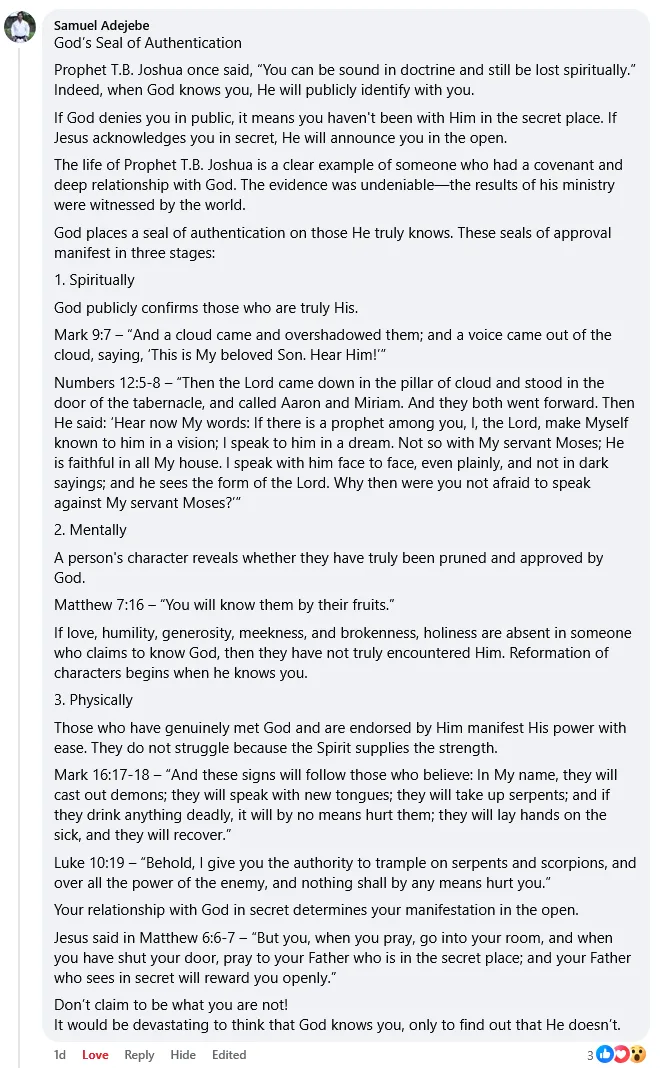
So… Who Are You to God?
Are you cultivating a heart that God recognizes? Would heaven call you a friend of God like Abraham? Scripture gives Abraham that exact title three times over: God calls him “My friend” in Isaiah 41:8, Scripture records that he “was called a friend of God” in James 2:23, and 2 Chronicles 20:7 calls him “your friend forever.” Abraham was not perfect. He lied about his wife twice out of fear. He fathered a child through Hagar instead of waiting on the promise. Yet none of that revoked the friendship, because friendship with God was never built on Abraham’s flawlessness. It was built on the fact that when God spoke, Abraham eventually obeyed, even when the instruction cost him comfort, safety, or his own understanding of what made sense.
Would the Lord boast in your character like He did with Job? This is not about striving to earn favor, but about walking daily with God in humility, letting your obedience echo louder than your titles.
This question tends to expose two different kinds of Christians. The first kind builds their identity from the outside in. They start with what people can see, the title, the platform, the testimony everyone applauds, and hope that enough of it will eventually add up to a relationship with God. The second kind builds from the inside out. They start with the hidden things, the prayer no one hears, the obedience no one witnesses, the character choices made when there is nothing to gain from them, and let whatever public fruit comes from that be a byproduct rather than the goal. Only one of those two builds something that survives the moment the applause stops.
What God Values
| What the World Notices | What God Values | Scripture |
|---|---|---|
| Titles and positions | Truth and sincerity | John 8:31–32 |
| Spiritual gifts and talent | Grace and availability | Ephesians 2:8–9 |
| Outward appearance and performance | The condition of the heart | 1 Samuel 16:7 |
| A public platform | Secret, unseen obedience | Matthew 6:6 |
| Loud, visible success | Quiet, consistent faithfulness | Luke 16:10 |
Samuel’s warning to himself while anointing David is worth sitting inside for a moment: even a prophet, standing in the actual presence of God’s chosen future king, almost missed him because he was looking at the wrong thing. “The LORD does not look at the things people look at. People look at the outward appearance, but the LORD looks at the heart” (1 Samuel 16:7). If a prophet could be tempted to judge by appearance, so can you, both in how you judge others and in how you quietly build a case for your own standing with God.
The Life Behind the Curtain
Every public ministry, every public testimony, every public post rests on top of a private life that nobody else ever sees. That hidden layer, not the visible one, is what God is actually watching.
“What you do in secret is what will answer you in the open. There is no shortcut to spiritual maturity. We are made spiritual by living in the Word and by the Word living in us.” — Prophet TB Joshua
Think about what that means practically. The prayer you pray when no one is recording it. The Bible you open when there is no post to make about it afterward. The moment you choose to forgive someone who will never know you were tempted to withhold it. The temptation you walked away from that no one saw you resist. These unseen choices are not the sideline of your Christian life. According to Prophet TB Joshua, they are the answer that eventually shows up in the open, whether that open moment is a testimony, a promotion, a peace that others cannot explain, or simply the quiet strength to stand when everything around you shakes.
Jesus taught this exact principle before Prophet TB Joshua ever repeated it in his own words:
“But when you pray, go into your room, close the door and pray to your Father, who is unseen. Then your Father, who sees what is done in secret, will reward you.” — Matthew 6:6
Notice that God does not merely observe the secret place. He rewards what happens there. This should reframe how you think about the parts of your walk with God that nobody applauds. The quiet obedience. The unnoticed sacrifice. The private tears. These are not wasted because no one saw them. They were seen by the only Witness whose opinion actually determines whether God knows you.
Gifts Are Not Proof, Character Is
Return again to Matthew 7:22–23, because it deserves a second, closer look. The people standing before Jesus on that day are not liars claiming powers they never had. They prophesied. They cast out demons. They performed miracles, in His name, and by every outward measure their ministries looked anointed. And still Jesus says, “I never knew you. Away from me, you evildoers!”
How is that possible? Because a spiritual gift operating through someone is not the same as a relationship existing between that person and God. Gifts can flow through a vessel God never fully possesses. Prophet TB Joshua taught this with unusual bluntness:
“In order to maintain God’s gift, we need God’s character.” — Prophet TB Joshua
A gift will open a door. Character is what determines whether you stay standing once you walk through it. This is why some of the most gifted ministers you have ever watched have also fallen the hardest, not because the gift stopped working, but because the character underneath it was never built to carry the weight the gift attracted. The anointing does not guarantee the man. The man determines what the anointing is eventually used for.
“Those who have the greatest and most positive impact on the society today are not concerned with fame or popularity.” — Prophet TB Joshua
If your gift is drawing you toward the crowd faster than your character is drawing you toward the secret place, something in you needs to be examined before it needs to be celebrated.
How to Be Known by God
If God knowing you is not automatic, and it is not earned by activity alone, what actually builds it? Scripture and the pattern in these lives point to a few deliberate, repeatable choices.
Cultivate a secret life with God that no one applauds. Prayer that has no audience, worship that produces no post, obedience that no one is around to witness. This is where relationship is actually built, not performed.
Let obedience cost you something. Abraham left his country before he knew the destination. Noah built a boat before it ever rained. If your obedience never costs you comfort, convenience, or reputation, ask honestly whether it is obedience or simply agreement.
Guard your heart the moment success arrives. Hezekiah wept in humility before his healing. David repented in humility after his failure. Both postures matter, but the harder one to maintain is humility after the blessing has already come. Watch yourself most closely in your increase, not only in your lack.
Close the gap between your stage and your secret closet. If the version of you that people see in public would surprise the people who actually live with you, that gap is exactly what needs attention. God is not impressed by a consistent stage presence built on top of an inconsistent private one.
Choose relationship over recognition, deliberately, every day. Prophet TB Joshua put it simply:
“Take care of the depth of your relationship with God and He will take care of the breadth of your success.” — Prophet TB Joshua
Depth first. Breadth follows. Reverse that order and you will spend your life managing a reputation instead of walking with a Father.
Ask Yourself: Who Am I to God?
Take a moment today. Not to list your accomplishments, but to ask:
“Lord, am I known by You?”
“Does God acknowledge me like He did Job or Daniel?”
Am I known in heaven for my obedience, humility, and faithfulness?
Is my prayer life a fragrance that reaches God’s throne, or a performance that reaches an audience?
If God described me to someone else the way He described Job to Satan, what would He actually say?
Is there a gap between who I am on a platform and who I am when no one is watching?
If we desire to be used by God, we must first desire to be known by Him—through surrender, humility, and faithfulness.
Final Encouragement: Seek to Be Known by God
Instead of trying to prove to others that you know God, seek to live a life that causes God to acknowledge you.
Live humbly. Obey His Word. Meditate on it daily. Serve with a sincere heart. Let your faith be rooted not in outward signs but in inward obedience. This is not a call to abandon ministry, gifting, or public witness. It is a call to make sure the private root beneath all of it is strong enough to hold the public fruit it is producing. A tree with a shallow root can still bear fruit for a season. It cannot survive the storm.
This is also not a call to anxiety, as though God’s knowledge of you were a pass or fail exam you could wake up tomorrow having failed. Relationship with God is not maintained through fear of exposure. It is maintained through the same daily returning that marked every name listed earlier in this post. Hezekiah wept and was heard. David sinned and repented and was still called a man after God’s own heart, not because he never fell, but because he never stayed fallen. Whatever distance you feel from God right now, today, is not a verdict. It is an invitation to turn back toward Him the way you would turn back toward anyone you love after time apart, without excuse, without performance, just presence.
Matthew 7:21–23 warns us that not everyone who says, “Lord, Lord,” will enter the Kingdom. Some cast out demons and did mighty works but were unknown to God because their hearts were far from Him. Let that warning do its work in you today, not as condemnation, but as an invitation. The door Jesus is describing in that passage is not closed to gifted people. It is closed to people whose gifting was never allowed to be searched by an honest relationship with the God it was supposed to represent.
Conclusion Prayer:
“Lord, I don’t just want to say I know You. I want to be known by You. Search me and know my heart today, the way You searched David’s. Try me and know my anxious thoughts (Psalm 139:23). Help me walk in humility and obedience so that heaven can recognize me. Let my private life match my public witness, and let my life reflect Your will. Let my heart be a place where You dwell, not a stage where I merely perform. In Jesus’ name, Amen.”
Good Morning 🌄 and PROSPER ✨ today!
Let this blog stir your spirit. Share it with someone who needs to hear this today, and continue your walk with God in deeper intimacy at www.spiritworshipgen.org.
Please like, follow and subscribe to our social media channels:
Facebook: Generation of Spiritual Worshippers - GOSW
YouTube: @spiritworshipgen
X (Former Twitter): @gensworshipper
Instagram: @spiritworshipgen
TikTok: @spiritworshipgen
Related Teachings




References
Published by SpiritWorshipGen – A Generation of Spiritual Worshippers
Comments
This discussion is closed for new comments.