Why Your Past Righteousness Cannot Save You From Today’s Sin
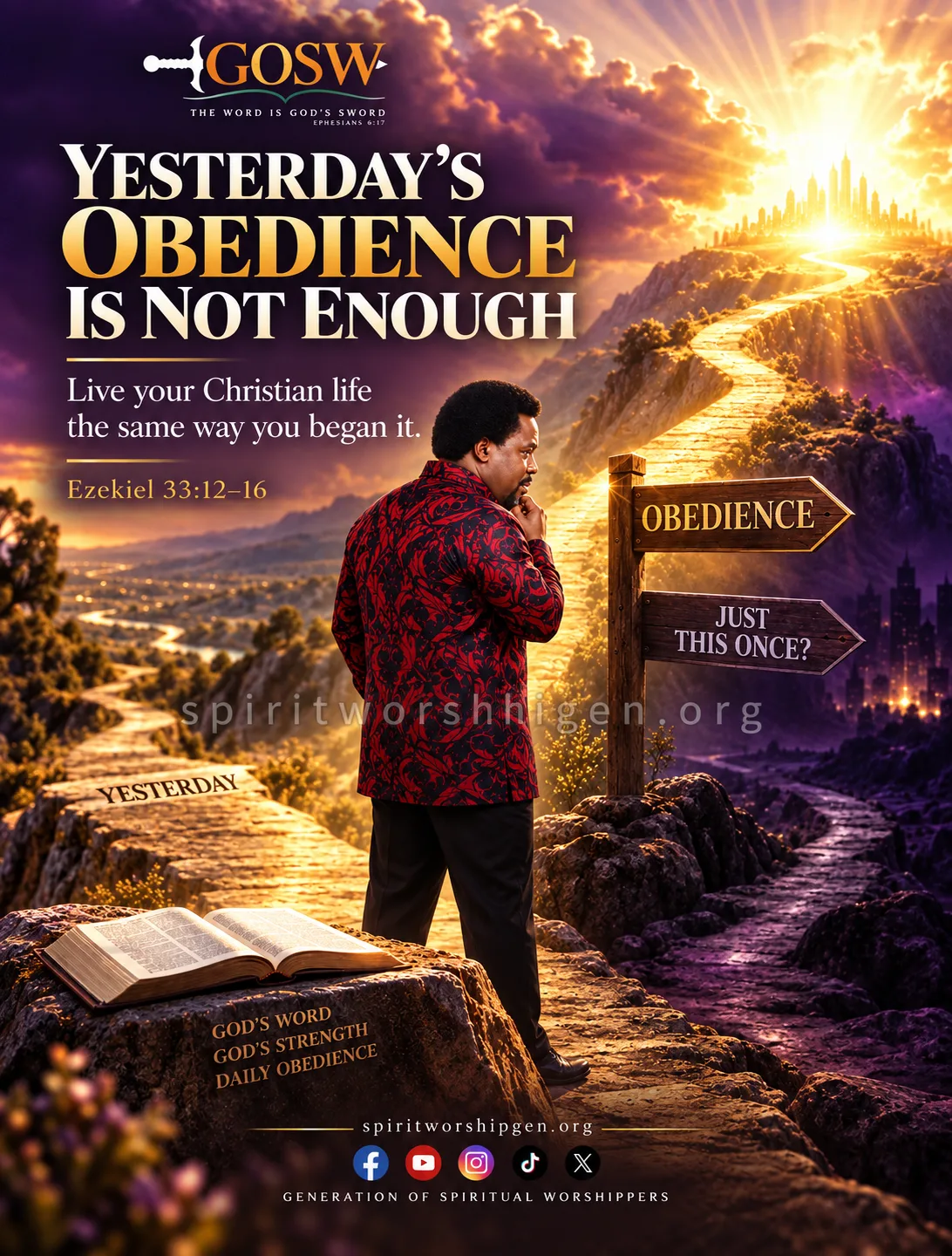
🌿 Why Your Past Righteousness Cannot Save You From Today’s Sin
“The righteous behavior of righteous people will not save them if they turn to sin… None of their past sins will be brought up again, for they have done what is just and right, and they will surely live.” — Ezekiel 33:12, 16 (NLT)
God is not keeping a scoreboard of your best days so He can excuse your worst one. He is asking one question, every single day: what are you doing with Him right now? That single question quietly dismantles two lies believers tell themselves in opposite directions. One lie says a strong track record buys room to sin “just this once,” because surely a life this faithful has earned a little leeway. The other lie says a long history of failure disqualifies you from ever truly coming home, no matter how genuinely you turn from it today. Ezekiel 33 destroys both lies in the same breath, and what is left standing when the dust clears is a standard that should terrify the proud and comfort the repentant in equal measure.
On this page
- Your righteousness has an expiration date the moment you turn
- The same mercy runs both ways: the wicked who turn are not held to their past
- Self-righteousness boasts in performance; God’s righteousness boasts in the cross
- Taking every thought captive before sin ever gets a vote
- Full-time Christian, not a part-time one with an escape clause
- Born of God, you do not make a practice of sinning
- Biblical heroes: when the past could not save them or condemn them
- Practical application: living in today’s righteousness
- Prayer
📜 Your Righteousness Has an Expiration Date the Moment You Turn
God’s word to Ezekiel is blunt and specific. It does not speak of a righteous person who stumbles once and repents. It speaks of a righteous person who sins while “expecting their past righteousness to save them.”
“When I tell righteous people that they will live, but then they sin, expecting their past righteousness to save them, then none of their righteous acts will be remembered. I will destroy them for their sins.” — Ezekiel 33:13 (NLT)
That phrase, “expecting their past righteousness to save them,” describes a very specific and very common trap. It is the voice that says, “just this once, because I have never done this before, God will overlook it.” It is the mental math that adds up every fast, every offering, every year of faithfulness, and treats that sum as a credit balance available to spend on a single act of disobedience. The believer who reasons this way is not asking whether the act is right. He is asking whether his track record can absorb the cost.
Scripture answers that question with a door slamming shut. None of the righteous acts will be remembered. Not most of them. Not the majority. None. Prophet TB Joshua captured the same principle in a single sentence that has followed this ministry from its very beginning:
“Live your Christian life the same way you began it.” — Prophet TB Joshua
Think about how you began. Hungry, desperate, holding nothing back, treating obedience as non-negotiable because you had just been rescued from something. That posture was never meant to be a starting phase you graduate out of once you accumulate enough spiritual mileage. Righteousness is not a bank account you build up and then draw down when it is convenient. It is the condition you are standing in today, and today alone is what God is asking about.
🔄 The Same Mercy Runs Both Ways: The Wicked Who Turn Are Not Held to Their Past
Ezekiel 33 is not a one-sided warning. The same chapter that refuses to let a righteous man coast on his history also refuses to let a wicked man’s history define his future, the moment he genuinely turns.
“Suppose I tell some wicked people that they will surely die, but then they turn from their sins and do what is just and right. For instance, they might give back a debtor’s security, return what they have stolen, and obey my life-giving laws, no longer doing what is evil. If they do this, then they will surely live and not die. None of their past sins will be brought up again, for they have done what is just and right, and they will surely live.” — Ezekiel 33:14-16 (NLT)
Notice what real repentance looks like in this passage. It is not a feeling. It is not a private apology whispered in the dark. It gives back the debtor’s security. It returns what was stolen. It obeys the life-giving laws it used to ignore. God’s mercy here is generous, but it is not naive. It watches for fruit, not just for words, because words cost nothing and fruit costs everything.
Prophet TB Joshua described that same generosity of God toward the truly repentant:
“God is always ready to readmit His people, who come to Him in humility and repentance, to the right position in His glory.” — Prophet TB Joshua
If you have been carrying shame over something you have already turned from, something you have already made right where you could, hear this clearly. God is not the one still bringing it up. He said He would not.
“Pardon puts peace in the heart of the one who truly repents.” — Prophet TB Joshua
That peace is not a reward for having sinned less than others. It is the fruit of having surrendered fully to the One who forgives completely.
🪞 Self-Righteousness Boasts in Performance; God’s Righteousness Boasts in the Cross
Here is the difference that decides everything in Ezekiel 33. Self-righteousness measures itself by what it has done for God. God’s righteousness is measured entirely by what God has already done for us. One is a resume. The other is a gift.
“We are all infected and impure with sin. When we display our righteous deeds, they are nothing but filthy rags” (Isaiah 64:6, NLT). That is not God’s opinion of the wicked. That is God’s opinion of our best religious performance, offered on its own merit, without grace underneath it. Paul made the same confession from the other direction, after decades of zealous religious achievement: “For everyone has sinned; we all fall short of God’s glorious standard. Yet God, in his grace, freely makes us right in his sight. He did this through Christ Jesus when he freed us from the penalty for our sins” (Romans 3:23-24, NLT).
Prophet TB Joshua put the whole gospel in one sentence:
“Jesus Christ did not come for the righteous but to seek for the unrighteous and bring them to the righteousness of God.” — Prophet TB Joshua
That single line dismantles both errors at once. It dismantles the pride of the person coasting on their own record, because Jesus was never looking for people who did not need Him. And it dismantles the despair of the person convinced their past disqualifies them, because Jesus came looking for exactly that person.
| Self-Righteousness | God’s Righteousness | |
|---|---|---|
| Its source | What I have done for God | What God has done for me |
| Its confidence | Track record, streaks, comparison to others | The finished work of the cross |
| Under pressure | Justifies “just this once” | Refuses every excuse, no matter the record |
| When it fails | Collapses into shame, denial, or self-defense | Runs back to grace instead of away from it |
| What it produces | Pride that forgets Ezekiel 33:13 | Humility that lives by Ezekiel 33:16 |
We are not doing God a favor when we refuse to sin. We are doing ourselves the greatest favor available to any human being, staying inside the only place where real life is found.
🧠 Taking Every Thought Captive Before Sin Ever Gets a Vote
Every act of disobedience in Ezekiel 33 began somewhere private, long before it became visible. Scripture traces the exact anatomy of that process: “Temptation comes from our own desires, which entice us and drag us away. These desires give birth to sinful actions. And when sin is allowed to grow, it gives birth to death” (James 1:14-15, NLT). Notice the order. Desire conceives before action is ever committed. Which means the real battlefield was never the act itself. It was the thought that was quietly given permission to stay.
This is why Paul instructs believers to fight the battle at its actual origin: “We destroy every proud obstacle that keeps people from knowing God. We capture their rebellious thoughts and teach them to obey Christ” (2 Corinthians 10:5, NLT). Capture, not negotiate with. Not entertain for a while to see where it leads. A thought that justifies sin with your own good history, “I have never done this before, so it is fine just this once,” is not a neutral thought waiting for a verdict. It is a rebellious thought that has already been armed and is waiting for your permission to act.
Prophet TB Joshua explained why that inner alarm exists at all:
“When we sin or attempt to do so, the Holy Spirit prompts our conscience to accuse us to repentance.” — Prophet TB Joshua
That uncomfortable nudge before you follow through on a compromise is not your imagination. It is the Spirit doing exactly what He was sent to do, giving you one more chance to take the thought captive before it becomes an action you cannot undo.
⏳ Full-Time Christian, Not a Part-Time One With an Escape Clause
If righteousness cannot be banked and spent later, then Christianity was never meant to be practiced in shifts. Prophet TB Joshua said it without softening the edges:
“Jesus Christ is looking for full-time followers not part-time followers.” — Prophet TB Joshua
Jesus warned a church in Revelation about the exact danger of a divided, part-time devotion: “I know all the things you do, that you are neither hot nor cold. I wish that you were one or the other! But since you are like lukewarm water, neither hot nor cold, I will spit you out of my mouth!” (Revelation 3:15-16, NLT). Lukewarm is not a milder form of faithfulness. It is the specific condition Jesus finds most intolerable, because it wants the name of a follower while reserving the right to walk away from the obedience.
He said something similarly uncompromising to a man who wanted to follow Him but first asked for one condition: “Anyone who puts a hand to the plow and then looks back is not fit for the Kingdom of God” (Luke 9:62, NLT). A covenant, whether with God or with another human being, only functions as a covenant when both sides are fully in. If you would not accept a spouse reserving the right to violate a marriage vow “just this once, because I have been faithful up until now,” do not expect God to accept a lesser standard from you in your covenant with Him. The benefits of that relationship, His protection, His presence, His promises, were never separate from the obedience the relationship requires.
🌱 Born of God, You Do Not Make a Practice of Sinning
The apostle John draws the same line Ezekiel drew, from a different angle entirely.
“Those who have been born into God’s family do not make a practice of sinning, because God’s life is in them. So they can’t keep on sinning, because they are children of God.” — 1 John 3:9 (NLT)
Read that carefully before you misapply it. This is not a claim to sinless perfection, and it is not a license to despair the first time you fall. It is a statement about direction and pattern, not about flawlessness. There is a real difference between a believer who stumbles and runs immediately back to God in genuine sorrow, and a believer who has built a comfortable, ongoing habit of sin, excused each time by a clean-sounding justification.
Paul confronted the second category directly: “Well then, should we keep on sinning so that God can show us more and more grace? Of course not! Since we have died to sin, how can we continue to live in it?” (Romans 6:1-2, NLT). Grace was never designed to be a safety net for planned disobedience. It is the power that frees you from sin’s grip, not a permission slip to test how far it stretches.
This is what makes Christianity a relationship rather than a religion. A relationship with God, carried out through His Word and by His Spirit, cannot survive on borrowed righteousness or a stockpile of past obedience. It survives, and grows, only in the present tense, one surrendered day at a time.
🚶 Biblical Heroes: When the Past Could Not Save Them or Condemn Them
King Saul, Anointed Yet Unable to Cash In His Early Obedience
Saul began his reign humbly, chosen by God, anointed by Samuel, even prophesying among the prophets. But when he later disobeyed God’s clear instruction regarding the Amalekites, his earlier record bought him nothing. “Has the Lord as great delight in burnt offerings and sacrifices, as in obeying the voice of the Lord? Behold, to obey is better than sacrifice” (1 Samuel 15:22). Samuel’s verdict was final: “Because you have rejected the word of the Lord, he has also rejected you from being king” (1 Samuel 15:23). Saul’s good beginning did not purchase him an exemption from present obedience.
King Manasseh, the Most Wicked King Whose Repentance Was Not Too Late
Manasseh filled Jerusalem with idols, rebuilt pagan altars, and led Judah into some of the darkest sin in its history. By any human measure, he should have been the least likely candidate for restoration. Yet Scripture records this: “In his distress he sought the favor of the Lord his God and humbled himself greatly before the God of his fathers… And he knew that the Lord was God” (2 Chronicles 33:12-13, NLT). God did not hold Manasseh’s decades of wickedness against him once he genuinely turned. His past sin could not condemn a present repentance, exactly as Ezekiel 33 promises.
The Thief on the Cross, a Lifetime of Sin Undone in a Single Turn
One of the criminals crucified beside Jesus had lived a life the world had already judged and sentenced. In his final hours, he turned. “Jesus, remember me when you come into your kingdom.” And Jesus replied, “I assure you, today you will be with me in paradise” (Luke 23:42-43, NLT). No penance, no years of proving himself, no opportunity to give back what he had stolen. Only a genuine turning of the heart, received instantly by a God who was never keeping score of how much time was left to earn it.
Judas and Peter, Two Men Who Failed Jesus the Same Night
Both men denied their Lord that night. Judas betrayed Him for silver. Peter denied even knowing Him, three times, with curses. The two failures were strikingly similar. The two endings were not. “Judas… was seized with remorse… Then he went away and hanged himself” (Matthew 27:3-5). Peter, by contrast, “went out and wept bitterly” (Matthew 26:75), and was later restored by Jesus Himself beside a charcoal fire, asked three times, “Do you love me?” and commissioned three times, “Feed my sheep” (John 21:15-17). The difference was never the size of the failure. It was the direction each man turned afterward, toward despair or toward the Father still waiting to receive him.
✅ Practical Application: Living in Today’s Righteousness
- Stop auditing your past to justify your present. The moment you catch yourself reasoning, “I have never done this before, so it is fine just this once,” recognize that thought for what it is, an attempt to spend righteousness that was never meant to be banked.
- Let repentance produce visible fruit, not just private regret. Ezekiel 33 shows wicked people returning what they stole and giving back the debtor’s security. If genuine repentance is real, it will cost you something concrete, not just a quiet feeling of sorrow.
- Take the thought captive before it becomes an action. Do not wait until the deed is committed to start praying about it. The battle in 2 Corinthians 10:5 is won or lost at the level of thought.
- Refuse the lukewarm middle. Decide, deliberately, that your walk with God will not run on a part-time schedule. Full surrender is the only posture Scripture ever describes as safe.
- When you fall, run to God immediately, the way Peter did. Do not let shame convince you to run from Him the way Judas did. His grace is not measured out based on how quickly or how often you have needed it before.
- Live today as though today is the only day being judged, because it is. Yesterday’s obedience does not carry today’s temptation, and yesterday’s failure does not have to define today’s surrender.
🙏 Prayer
Lord, forgive me for every time I have tried to spend the righteousness of yesterday on the disobedience of today. Forgive me for the thoughts I entertained instead of taking captive, and for the times I let my track record talk me into compromise. Thank You that my past sins are not being held against me the moment I genuinely turn to You. Teach me to live my Christian life today the same way I began it, fully surrendered, fully Yours, holding nothing back. Give me Peter’s readiness to run back to You and never Judas’s despair. In Jesus’ name, Amen.
Good Morning 🌄 and PROSPER ✨ today!
Let this blog stir your spirit. Share it with someone who needs to hear this today, and continue your walk with God in deeper intimacy at www.spiritworshipgen.org.
Please like, follow and subscribe to our social media channels:
Facebook: Generation of Spiritual Worshippers - GOSW
YouTube: @spiritworshipgen
X (Former Twitter): @gensworshipper
Instagram: @spiritworshipgen
TikTok: @spiritworshipgen
Related Teachings


References
[Facebook post link — add after publishing]
Published by SpiritWorshipGen – A Generation of Spiritual Worshippers
Comments
This discussion is closed for new comments.