Can the Holy Spirit Leave You?
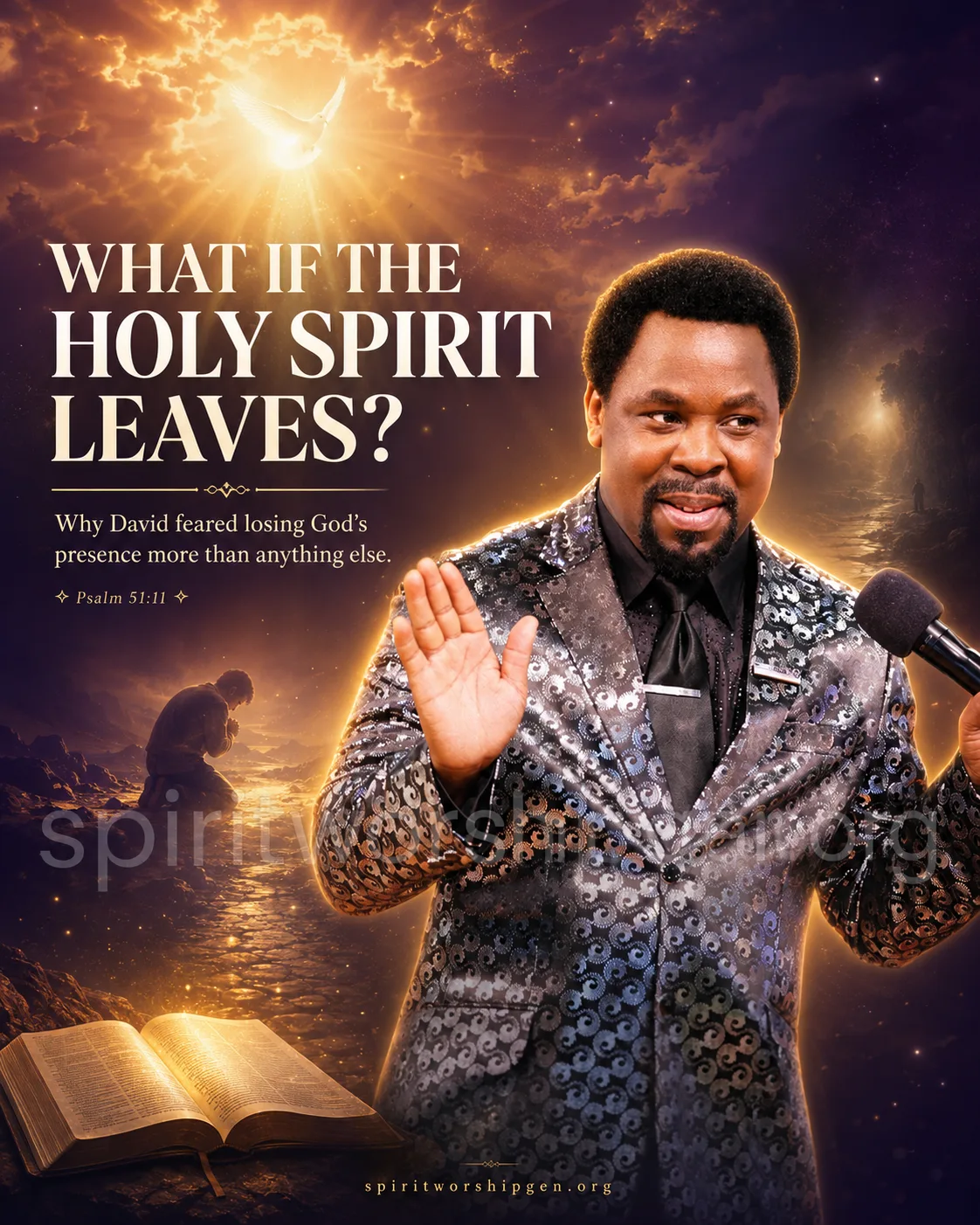
🌿 Do Not Take Your Holy Spirit From Me: What David Feared Losing Most
“Do not banish me from your presence, and don’t take your Holy Spirit from me.” — Psalm 51:11 (NLT)
After his sin with Bathsheba, David lost nothing that history remembers as valuable. He kept his throne. He kept his wealth. He kept his reputation among the nations that still feared Israel’s king. Yet listen to what he begged God not to take from him. Not the crown. Not the kingdom. Not his name before men. He begged God not to take the Holy Spirit.
That single request tells you everything David had learned in a lifetime of walking with God: the presence of the Holy Spirit is worth more than every other thing a man can lose, and it is possible, through persistent sin, to grieve that presence away.
On this page
- The voice that warns you before you fall
- How you know the Holy Spirit lives in you
- What grieves the Holy Spirit
- The journey from temptation back to obedience
- Case study: the lie that would not let him rest
- Case study: when desire crossed a line it shouldn’t have
- What happened when the Spirit left Saul
- Conviction is not condemnation
- How to keep the Holy Spirit’s voice loud in your life
- The ultimate goal: baptism of the Holy Spirit
- Prayer
👂 The Voice That Warns You Before You Fall
David had watched what happened to King Saul, a man who once carried the Spirit of God, become a man tormented after that Spirit departed from him. David himself had stood before Saul and played the harp while the king was being tortured by what filled the vacancy the Spirit left behind. So when David fell into his own sin, he already knew what was truly at stake, and it was not his position.
His plea forces us to examine our own relationship with the Holy Spirit in the same terms. When you are about to make a wrong choice and something within you says, “Don’t do it,” who is speaking to your heart? And when you ignore that warning, do what is wrong, and afterward your conscience grows restless and says, “What you did was wrong,” what is happening inside you?
The Holy Spirit does not only help us after we fall. He helps us before we fall. Before the lie, He prompts you: tell the truth. Before you cross the boundary into sexual sin, He warns you: don’t go further. And when we ignore His prompting and fall anyway, He does not approve of our sin, and He does not look away from it either. He convicts our conscience and calls us to repentance.
This is why Jesus did not merely tell His disciples to pray. He told them to watch.
“Watch and pray so that you will not fall into temptation. The spirit is willing, but the flesh is weak.” — Matthew 26:41 (NIV)
To watch is to recognize what is happening before temptation becomes sin. To pray is to acknowledge that without the help of the Holy Spirit, our human strength is not enough to say no. Prophet TB Joshua said it without qualification:
“No one can say No to sin without the help of the Holy Spirit.” — Prophet TB Joshua
So the deeper question is not merely, do I have the Holy Spirit? It is, am I listening to Him? Because between temptation and sin there is always a choice, and many times, before that choice is ever made, the Holy Spirit has already spoken.
🔑 How You Know the Holy Spirit Lives in You
You may ask, honestly, whether you really have the Holy Spirit at all. You do. When you do wrong and feel convicted in your heart, it is not the devil producing that feeling. It is the Holy Spirit who lives in you.
“The Spirit of truth. The world cannot accept him, because it neither sees him nor knows him. But you know him, for he lives with you and will be in you.” — John 14:17 (NIV)
Prophet TB Joshua described exactly how that indwelling Spirit reaches you day to day:
“Your conscience is the very instrument used to guide you by the Holy Spirit.” — Prophet TB Joshua
One clear evidence that the Holy Spirit is at work in you is peace of heart, the kind the world cannot manufacture and cannot take from you once it is settled. David urges every believer toward this same pursuit:
“Search for peace, and work to maintain it.” — Psalm 34:14 (NLT)
What kind of peace is worth searching for and fighting to keep? Jesus answers that question Himself.
“I am leaving you with a gift, peace of mind and heart. And the peace I give is a gift the world cannot give. So don’t be troubled or afraid.” — John 14:27 (NLT)
If you have never traced where that peace actually comes from, The One Gift the World Cannot Give You? unpacks it further. It is not a mood you talk yourself into. It is a Person present in you, and His presence is felt long before it is explained.
💔 What Grieves the Holy Spirit
The Holy Spirit lives with you now, and He wants to remain in you permanently. But He is easily grieved by sin and by disobedience to God’s commands.
“And do not bring sorrow to God’s Holy Spirit by the way you live. Remember, he has identified you as his own, guaranteeing that you will be saved on the day of redemption.” — Ephesians 4:30 (NLT)
The Holy Spirit cannot be Himself in you while you harbor offense, unforgiveness, hatred, bitterness, anger, the pain of the past, or envy, so He does not stay comfortably where those things are welcome. God does not evict His Spirit the moment you sin once, but persistent, unrepented sin creates an atmosphere His Spirit will not remain settled in until you repent and see your wrong.
People of God, the Holy Spirit living in you does not take away your power of choice. When you attempt to sin, or even when you merely consider it, He prompts your conscience to accuse you toward repentance. He convicts you of sin and guides you into all truth.
“And when he comes, he will convict the world concerning sin and righteousness and judgment… But when he, the Spirit of truth, comes, he will guide you into all the truth.” — John 16:8,13 (NIV, paraphrase)
“When we sin or attempt to do so, the Holy Spirit prompts our conscience to accuse us to repentance.” — Prophet TB Joshua
David said don’t take your Holy Spirit from me because he understood exactly what happens each time a man makes a serious mistake before God. But David also understood something else: as soon as he made that mistake, he ran to God quickly, acknowledged what he had done, and sought God’s mercy.
“For I recognize my rebellion; it haunts me day and night.” — Psalm 51:3 (NLT)
To be haunted day and night is to have a conscience that will not rest, a guilt that overwhelms until it is dealt with honestly. This is the Holy Spirit’s work. David understood that if he did not run to God, the Spirit would not stay comfortable where he remained.
🗺️ The Journey from Temptation Back to Obedience
Let us make this practical. The process a believer moves through, from the first suggestion of sin to a restored walk with God, can be summarized in eight stages:
Temptation → Choice → Sin → Conviction → Confession → Repentance → Restoration → Renewed Obedience
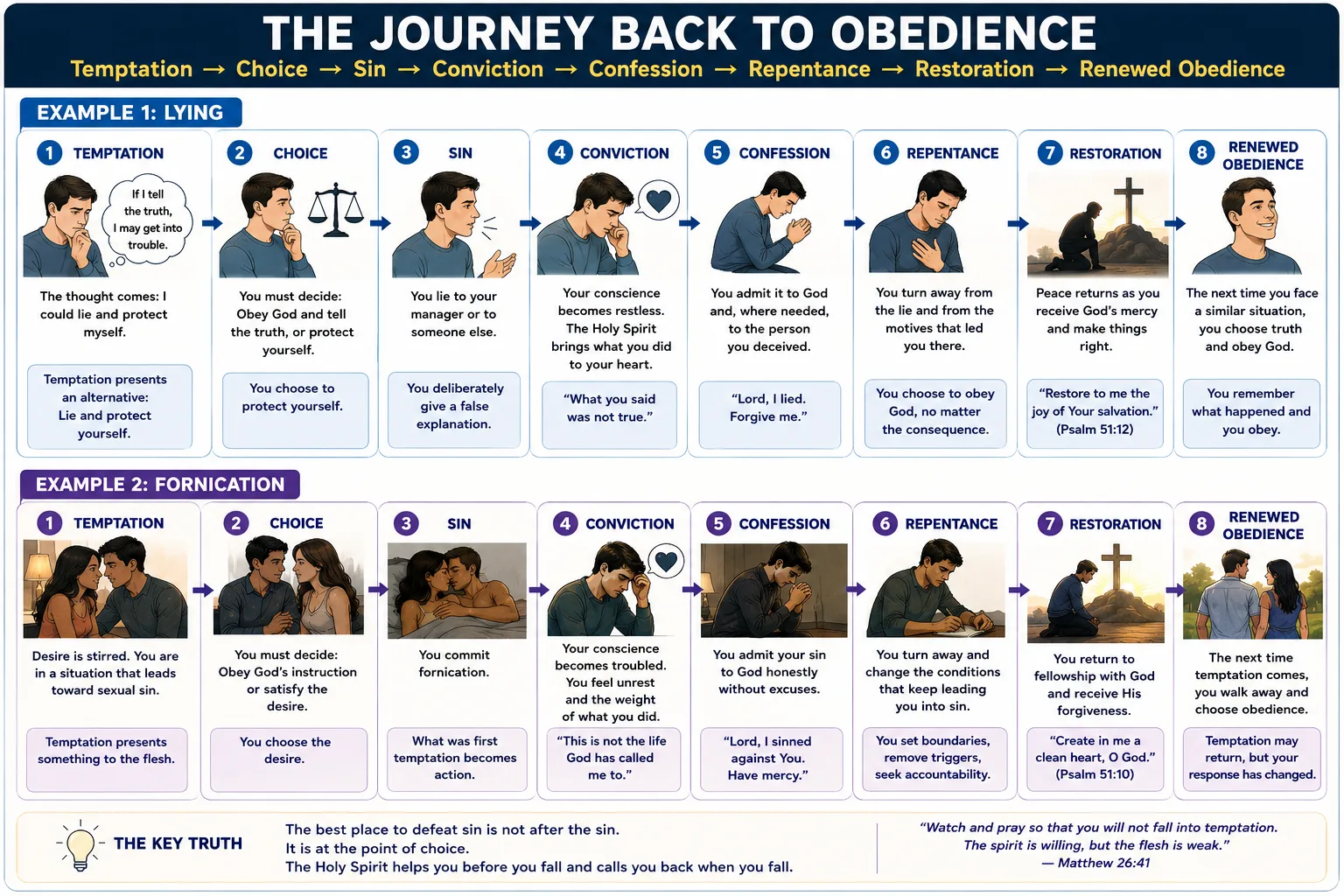
Notice something important about the whole sequence before we walk through it with real examples. The Holy Spirit is not only present at the conviction stage, the fourth step. He is already helping you at the choice stage, the second. Before the lie, something said, tell the truth. Before the wrong desire was acted on, something said, don’t go further. After the fall, that same voice does not condemn you into hiding; it calls you back. He was helping you before the fall, and He is calling you back after it.
This is why the best place to defeat sin is not after the sin. It is at the point of choice, and watching for that point is exactly what Jesus meant when He said watch and pray.
🤥 Case Study: The Lie That Would Not Let Him Rest
Picture an ordinary failure. You make a mistake at work. Your manager asks what happened, and you sense immediately that the truth may embarrass you or expose you to consequences.
Temptation arrives first, quiet and reasonable: if I tell the truth, I may get into trouble. At this point you have not yet sinned. A thought is not a sin. You have simply been presented with a choice.
Choice follows almost at once. You know the truth, but fear tells you to hide it. Your conscience says speak honestly; your flesh wants to avoid the consequence. You choose to protect yourself.
Sin is the lie itself, the false explanation you deliberately give your manager. Perhaps it works. Perhaps nobody ever discovers what really happened. Outwardly you escaped. Inwardly, something has already begun.
Conviction shows up as a restless conscience. The conversation keeps returning to your heart. You know that although you escaped consequences before men, you did not escape the knowledge of God. This is where the Holy Spirit’s conviction becomes mercy, calling your attention to what you have done before the lie has time to settle into your character.
Confession is where the excuses have to stop.
Not: “Lord, You know I was under pressure.” Not: “Everyone would have done the same thing.” But: “Lord Jesus, I lied because I was afraid of the consequences. I chose to protect myself instead of obeying You. Forgive me.”
Because another person was deceived, confession may also require going back to them and saying plainly, what I told you earlier wasn’t true; this is what actually happened, and I am sorry.
“Confession brings freedom.” — Prophet TB Joshua
Repentance turns away from the lie. Confession acknowledges what happened; repentance changes direction. You decide that protecting your relationship with God matters more than protecting your reputation before men, and you become willing to accept whatever consequence comes from finally telling the truth.
Restoration follows as peace returns. You have stopped hiding. You have brought the matter before God, corrected what needed correcting, and received His forgiveness. This is what David desired after his own sin: “Restore to me the joy of your salvation, and make me willing to obey you” (Psalm 51:12, NLT).
Renewed obedience is proven, not felt. Some weeks later another mistake happens. Telling the truth may again cost you something. The same temptation returns, but this time you remember what happened before. You pray, Holy Spirit, help me, I will tell the truth, and you do. The temptation may return, but your response to it has changed. That is the whole point of the journey.
🔥 Case Study: When Desire Crossed a Line It Shouldn’t Have
Now picture two unmarried believers who love each other and intend to marry, but who repeatedly find themselves in situations where sexual temptation grows strong.
Temptation presents itself simply: they are alone together, and affection begins to stir desire. Temptation itself is still not sin. It only asks the flesh a question: will you take it?
Choice is the decisive moment. They know God’s instruction concerning sexual purity, yet the reasoning starts: we love each other, we’re going to marry anyway, nobody will know, surely God understands. Beneath every explanation sits one plain question, what does God actually say. They choose the desire instead.
Sin follows. What began as temptation becomes an action; what was decided in the heart has now been expressed through the body.
Conviction arrives afterward as restlessness. Prayer becomes uncomfortable. The memory keeps returning. Something within says, this is not the life God has called you to. Do not despise that discomfort or try to silence it quickly. Sometimes the discomfort you feel after doing wrong is evidence that your conscience is still answering to God, exactly as David wrote: “For I recognize my rebellion; it haunts me day and night” (Psalm 51:3).
Confession stops making excuses.
Not: “We just went too far.” Not: “It happened because we love each other.” But an honest acknowledgment before God: “Lord Jesus, I knew Your instruction, but I chose the desire of my flesh. I sinned against You. Have mercy on me and forgive me.”
Repentance is where things become practical, because confessing today while deliberately recreating the same conditions tomorrow leaves the door open to the same fall. Real repentance may mean:
- Not spending the night together.
- Not remaining alone together in places where self-control has already broken down before.
- Setting clear physical boundaries in advance, not in the moment.
- Refusing to keep feeding the desires that repeatedly lead into sin.
- Seeking mature Christian accountability where it is needed.
Repentance is not only asking God to forgive what happened. It is turning away from the path that keeps leading there.
Restoration requires understanding the difference between conviction and condemnation. Condemnation says, look at what you have done, God doesn’t want you anymore, hide from Him. Conviction says, what you did was wrong, come back to God. David did not let his failure make him run permanently away. He cried, “Create in me a clean heart, O God. Renew a loyal spirit within me” (Psalm 51:10, NLT). Restoration is not pretending the sin never happened. It is returning to fellowship with God through genuine repentance and receiving His mercy.
Renewed obedience is tested again when the same temptation returns. The love has not disappeared. The desire has not magically vanished. The flesh may still be weak. But instead of waiting until temptation becomes overwhelming, they act earlier this time. They recognize the situation, they leave, they pray, they maintain the boundary, and they refuse to renegotiate with what previously defeated them. The proof of repentance is not merely how badly you felt about yesterday’s sin. It is how you respond when tomorrow presents the same opportunity again.
👑 What Happened When the Spirit Left Saul
David was worried about the Holy Spirit leaving him because he had already watched it happen to someone else, and he had seen exactly what it cost.
“Now the Spirit of the LORD had left Saul, and the LORD sent a tormenting spirit that filled him with depression and fear.” — 1 Samuel 16:14 (NLT)
“And whenever the tormenting spirit from God troubled Saul, David would play the harp. Then Saul would feel better, and the tormenting spirit would go away.” — 1 Samuel 16:23 (NLT)
Saul could not maintain the peace of God in his heart, so he had to search for temporary alternatives, and music was only ever a temporary relief, never a cure. This is exactly why David urged all of us to search for peace, and work to maintain it (Psalm 34:14). When the Spirit of God leaves a person, something happens immediately. There is no vacuum, and there is no neutral kingdom left standing empty. Whatever occupied that space before returns, or something worse moves in, bringing with it fear, depression, anger, hatred, envy, bitterness, jealousy, discontentment, worry, doubt, anxiety, inferiority, and sinful thoughts.
You may suddenly begin to question whether you are still a believer at all. That very question can be a sign that the Spirit’s settled presence has been grieved away by unrepented sin. When your temptation grows into what is uncommon among ordinary struggles, take that as your clue.
“The temptation you face is no different from what others experience. And God is faithful. He will not allow the temptation to be more than you can stand.” — 1 Corinthians 10:13 (NLT, paraphrase)
When we move away from God’s will through persistent, unrepented disobedience, we expose ourselves to consequences and spiritual attacks God never intended us to embrace. This is exactly why David pleaded, do not banish me from your presence and don’t take your Holy Spirit from me. He knew, from watching Saul at close range, precisely what silence in that presence would cost him.
⚖️ Conviction Is Not Condemnation
Three men in Scripture faced the same basic crisis, guilt after failure, and their responses to that guilt produced three completely different endings.
| Conviction (the Holy Spirit’s voice) | Condemnation (a counterfeit voice) | |
|---|---|---|
| What it says | “What you did was wrong. Come back to God.” | “Look at what you have done. God doesn’t want you anymore. Hide.” |
| Where it points you | Toward confession, repentance, restoration | Toward shame, isolation, despair |
| David’s response | Ran toward God — “Create in me a clean heart” (Psalm 51:10) | Refused to let guilt push him away permanently |
| Judas’s response | Felt remorse — “I have sinned by betraying innocent blood” (Matthew 27:4) | Moved toward destruction instead of toward Christ |
| Peter’s response | Denied Jesus, then wept bitterly (Luke 22:62) | Eventually returned and was restored (John 21:15–17) |
David felt the weight of his sin and ran toward God, not away from Him. Judas felt remorse and moved toward destruction. Peter denied Jesus, wept bitterly, and eventually returned to Christ. The guilt itself was not the deciding factor for any of the three. What each man did with that guilt was. Conviction should always lead to repentance, never to condemnation, and the enemy’s oldest trick is to make conviction feel like condemnation so that a repentant heart runs the wrong direction.
🛡️ How to Keep the Holy Spirit’s Voice Loud in Your Life
Knowing the pattern is not the same as walking in it. A few practical commitments keep the Spirit’s warning voice clear instead of faint:
- Answer the first prompting, not the fifth. The Spirit usually speaks quietly and early, at the choice stage, not loudly and late, at the conviction stage. The sooner you obey the first nudge, the less ground temptation gains.
- Deal with offense and bitterness quickly. These are named directly as things that make it impossible for the Holy Spirit to be Himself in you. An unforgiving heart is not a small, private matter; it is an atmosphere the Spirit will not settle comfortably in.
- Run to God the moment you fall, not after you’ve composed yourself. David’s rebellion haunted him day and night precisely because he refused to numb it. That restlessness was mercy, not punishment, and it worked because he responded to it quickly.
- Treat conviction and condemnation as opposites, not synonyms. When guilt tells you to hide from God, recognize that voice as counterfeit. The Spirit convicts to draw you closer, never to push you further away.
- Remove the conditions that keep producing the same fall. Confession without changed conditions is only ever a pause, not repentance. If a particular place, person, or habit keeps reopening the same temptation, that is the practical boundary repentance is asking you to set.
- Feed on peace as evidence, not just feeling. The peace Jesus gives is a gift the world cannot manufacture and cannot take away once it has settled. When that peace disappears, treat it as information, not merely mood.
For a fuller, dedicated look at sustaining the Holy Spirit’s presence day to day, read How to Maintain the Holy Spirit Living in You in a Modern World.
🕊️ The Ultimate Goal: Baptism of the Holy Spirit
The day you truly accept Jesus as Lord and Savior, the Holy Spirit begins to live with you, helping you obey God’s commands and helping you make right choices. Take note carefully: He suggests the right thing to you. He does not force the choice for you.
“God is Spirit; without the Holy Spirit you cannot relate to Him.” — Prophet TB Joshua
The ultimate goal of every believer is for the Holy Spirit not merely to visit but to remain, to never leave, to adopt you permanently as His own. This is what it means to be born again, born of the Spirit. For that permanent indwelling to occur, the baptism of the Holy Spirit must take place. When that baptism happens, you no longer navigate life by your own power of choice alone; the Holy Spirit leads, choosing what you say, what you do, where you go, and what you go through, while you choose how you go through it. Water baptism becomes symbolic once Spirit baptism has occurred; the outward sign points to an inward reality that has already begun. From that point, you relate to God directly and labor on His work in the earth.
“No, I will not abandon you as orphans, I will come to you.” — John 14:18 (NLT)
David felt the weight of his sin and ran toward God, not away from Him. That single instinct, running toward instead of away, is what separated his story from Saul’s and from Judas’s. His conviction did not condemn him into hiding. His conviction made him run back to God.
🙏 Prayer
Lord, teach me to hear Your voice before I fall, not only after. Where I have grieved Your Spirit through offense, bitterness, or unrepented sin, forgive me and cleanse me. When conviction comes, let it draw me closer instead of pushing me into hiding. Give me the grace to run to You quickly, the way David did, and to remove the conditions that keep producing the same fall. Holy Spirit, do not leave me. Stay, and make me willing to obey You. In Jesus’ name, Amen.
Good Morning 🌄 and PROSPER ✨ today!
Let this blog stir your spirit. Share it with someone who needs to hear this today, and continue your walk with God in deeper intimacy at www.spiritworshipgen.org.
Please like, follow and subscribe to our social media channels:
Facebook: Generation of Spiritual Worshippers - GOSW
YouTube: @spiritworshipgen
X (Former Twitter): @gensworshipper
Instagram: @spiritworshipgen
TikTok: @spiritworshipgen
Related Teachings




References
🌿 Can the Holy Spirit leave you?
🌿 GOSW: Can the Holy Spirit leave you?
Published by SpiritWorshipGen – A Generation of Spiritual Worshippers
Comments
This discussion is closed for new comments.