What Is the Difference Between Dreams and Visions?

🌿 God Still Speaks in Dreams and Visions
“In the last days, I will pour out my spirit on all people. Your sons and daughters will prophesy, your young men will see visions, your old men will dream dreams.”
— Acts 2:17
Dreams are one of the ways God has chosen to reveal His purposes throughout Scripture. From Joseph in Egypt to Daniel in Babylon to Peter on a rooftop in Joppa, God has never been silent. He has always had a way of speaking to His people, even when their eyes were closed and their guard was down.
Many believers experience dreams and visions but do not know how to tell the difference between the two, or what to do once revelation comes. This post walks through the biblical pattern behind both, why understanding often arrives after the revelation and not before it, and what a genuine encounter with a dream fulfilled years later can teach us about how patiently God works out His word.
On this page
- Why does God give dreams and visions?
- What is the difference between dreams and visions?
- The pattern of visions throughout Scripture
- Why revelation often comes before understanding
- The pattern of dreams throughout Scripture
- Biblical examples: God warns us through dreams
- The pattern behind every revelation: perplexed, then patient, then understood
- The different ways God speaks to His children
- My dream confirmed two years later
- How should Christians respond?
- Prayer
🕯️ Why Does God Give Dreams and Visions?
“In a dream, in a vision of the night, when deep sleep falls on men, while slumbering on their beds, then He opens the ears of men, and seals their instruction.”
— Job 33:15–16
Throughout Scripture, God has used dreams and visions to warn, prepare, guide, encourage, and reveal. He warned Pharaoh through dreams of coming famine. He prepared Daniel in Babylon through visions no one else could interpret. He guided Peter through a trance on a rooftop that would break open the gospel to the Gentiles. The method changes from person to person, but the purpose is the same: God communicating what human effort alone could never uncover.
Prophet TB Joshua taught something that anchors this entire subject:
“Our God is merciful; He never keeps us in the dark about future events.” — Prophet T.B. Joshua
That single sentence should settle a lot of anxiety in the heart of a believer. If dreams and visions did not exist as a mode of divine communication, we would be left entirely to guesswork about what tomorrow holds. But God, in His mercy, chooses to prepare His children in advance, sometimes through the plain reading of His Word, and sometimes through what happens while they sleep or while they are caught up in the Spirit.
Not every dream is spiritual, and not every vision is from heaven. But when a dream or vision genuinely comes from God, it carries a weight that ordinary dreams do not carry. It does not merely pass through your memory and fade by breakfast. It settles in your spirit.
🌙 What Is the Difference Between Dreams and Visions?
Dreams and visions are often spoken of together, and rightly so, since both are legitimate channels through which God communicates. But they are not identical, and Scripture is careful to distinguish between them.
A dream occurs while a person is asleep. A vision occurs while a person is awake, or in a trance. A trance is not sleep. Acts chapter 10 makes this distinction unmistakably clear, because within the same chapter we see Cornelius receive a vision while praying in broad daylight, and Peter receive a vision while fully conscious, though caught up beyond his natural senses.
Not every dream is from God, but when it is, it lives in your spirit, not just your memory. This is an important test. Ordinary dreams, the kind produced by a busy mind or a heavy meal, tend to dissolve within minutes of waking. A dream from God tends to stay. It returns to your thoughts unprompted. It refuses to be dismissed as random.
“When God wants to prepare you for something, He first speaks to your spirit, even while you sleep.” — Prophet T.B. Joshua
Here is a simple comparison to help you hold the distinction clearly in your mind:
| Feature | Dreams | Visions |
|---|---|---|
| State of the recipient | Asleep | Awake, or in a trance |
| Common time of occurrence | Mostly at night | Mostly during the day |
| Who receives them | Believers and unbelievers alike | Much more commonly associated with God’s servants |
| Where they tend to happen | In private, at rest | In quiet, private places during devotion |
| What fuels them | The condition of the heart | Daily habits of prayer, fasting, and worship |
| Nature of the content | Mostly personal and futuristic | Often symbolic and deeply perplexing |
| Response required | Interpretation from God | Interpretation from God |
Both dreams and visions require interpretation. Neither can safely be explained by human logic alone, because both originate outside natural understanding. That single requirement, the need for divine interpretation, is what should keep every believer humble and patient whenever revelation comes.
👁️ The Pattern of Visions Throughout Scripture
Jeremiah’s Vision. The prophet Jeremiah received a vision of two baskets of figs, one good and one spoiled beyond eating, in Jeremiah 24. Through this simple, everyday image, God communicated His plan concerning the exiles of Judah, some destined for restoration, others for continued judgment. The vision was plain to see but required God’s own explanation to be understood correctly.
Cornelius’ Vision. Cornelius received a vision from God Almighty in Acts 10, at about three o’clock in the afternoon, while he was praying.
“Cornelius replied, ‘Four days ago I was praying in my house about this same time, three o’clock in the afternoon. Suddenly, a man in dazzling clothes was standing in front of me…’”
— Acts 10:30
Notice that this vision did not arrive in the dead of night. It came in the middle of the afternoon, while Cornelius was in the middle of his devotion. Visions in Scripture are much more commonly associated with God’s servants, they often happen in the daytime, and they are fueled by daily habits of prayer and seeking God.
Peter’s Vision. While a meal was being prepared for him, Peter fell into a trance.
“He saw the sky open, and something like a large sheet was let down by its four corners. In the sheet were all sorts of animals, reptiles, and birds. Then a voice said to him, ‘Get up, Peter; kill and eat them.’”
— Acts 10:11–13
“Peter was very perplexed. What could the vision mean? Just then the men sent by Cornelius found Simon’s house. Standing outside the gate…”
— Acts 10:17
A trance is a personal consciousness temporarily suspended, meaning Peter was in deep meditation but not sleeping. He received this vision three times, which, as Joseph said to Pharaoh in Genesis 41:32, means the matter has been firmly decided by God. Genesis 41 gives us the principle that repetition signifies certainty. When God repeats a revelation, He is not being redundant. He is confirming that what has been shown is settled and will surely come to pass.
Daniel’s Visions. Daniel had a routine prayer habit. He prayed three times a day, as recorded in Daniel 6:10. As a result of his intimacy and devout relationship with God, Daniel would often receive visions, and angels would come to provide the understanding he asked for whenever he could not grasp their meaning on his own.
Daniel’s visions often troubled and terrified him, as we see in Daniel 7:15. They required divine interpretation because Daniel himself did not understand them. He asked for understanding in Daniel 7:16, and again in Daniel 7:19–20. These visions cannot be explained by men. You have to ask God for understanding, as recorded also in Daniel 8:15. While Daniel was fasting and praying a prayer of intercession for his people in Daniel 9, Angel Gabriel came to explain an earlier vision he had received. And in Daniel 10:4–21, while he was fasting and praying for twenty-one days, he saw a vision while standing beside the great Tigris River.
Many of the visions recorded in Scripture came during seasons of prayer, fasting, worship, waiting on God, or spiritual devotion. Intimacy with God prepares the heart to receive revelation. Consider the consistent pattern:
- They happen in quiet, private places.
- They are much more commonly associated with God’s servants.
- They often happen in the daytime.
- They are fueled by daily habits of devotion.
- They are difficult for the people who receive them to understand on their own.
- They are perplexing and very deep, shown to men in deep relationship with God.
🌌 Why Revelation Often Comes Before Understanding
Visions always need interpretation, as we see in Acts 10:17 and 19. Peter did not understand the vision at the time he received it. Scripture says he was perplexed. He was still puzzled by what he had seen. He only understood the vision once he arrived at the home of Cornelius, in Acts 10:28–29.
“He said to them, ‘You are well aware that it is against our law for a Jew to associate with or visit a Gentile. But God has shown me that I should not call anyone impure or unclean…’”
— Acts 10:28
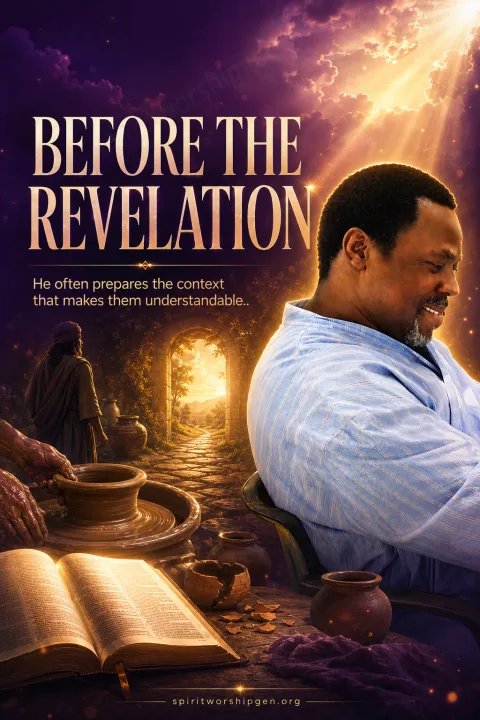
God gave Peter the vision, but the context explained it. The visit to Cornelius’ home was the very context Peter needed to understand the revelation he had already received. Sometimes God gives revelation first and understanding later. Peter’s vision happened during his routine prayer and fasting on the rooftop. You can read more on this in How God Uses Context In Divine Revelation, where this same principle is examined in greater depth.
Prophet TB Joshua described exactly this kind of unfolding:
“When God is executing His plan in our lives, He also designs and arranges events which will continue to unfold until His purpose is revealed.” — Prophet T.B. Joshua
And in a related word, he also said:
“God often uses anything to prepare you, stop you for a while to rearrange your future.” — Prophet T.B. Joshua
Notice the pattern God consistently uses: He reveals first, then He arranges the circumstances that make the revelation plain. This is why patience matters so much in the life of a believer who has received a dream or vision. The revelation is not incomplete because you do not yet understand it. It is simply waiting for its context to arrive.
🛌 The Pattern of Dreams Throughout Scripture
Now let us turn to dreams specifically. Jacob had a dream in Genesis 28, but notice that it happened at night, while he slept with a stone for a pillow.
“He had a dream in which he saw a stairway resting on the earth, with its top reaching to heaven, and the angels of God were ascending and descending on it.”
— Genesis 28:12
Take note of this difference between dreams and visions. Dreams are oftentimes referred to as visions of the night. Dreams and visions are received in the heart. If your heart is not in tune with God, you will mostly forget the events that happen in your dreams. This is why meditation on God’s Word is necessary, to prepare your heart to stay in tune with God’s frequency.
“You don’t necessarily need to sleep to receive dreams. You can be busy doing something and the dream will just pass. Dreams are all about our divine nature, not human nature. Our divine nature does not sleep.” — Prophet T.B. Joshua
This teaching reframes something many believers misunderstand. Dreams are not merely a biological event of the sleeping brain. At their spiritual root, they concern your divine nature, the part of you made to commune with God, which never actually rests the way your body does.
📜 Biblical Examples: God Warns Us Through Dreams
- Pharaoh (Genesis 41): God warned Pharaoh of a coming famine through two dreams, later interpreted by Joseph.
- The Wise Men (Matthew 2:12): Warned in a dream not to return to Herod, they protected the young Christ child by taking another route home.
- Pilate’s Wife (Matthew 27:19): Warned in a dream about Jesus’ innocence, she sent an urgent message to her husband while he sat on the judgment seat.
- Potiphar’s Cupbearer and Baker (Genesis 40:8): Both men had dreams in the prison cell about events that would define their futures, one restored, the other executed within three days.
These examples show that God has always used dreams to guide, warn, and reveal His will to His people. Dreams are mostly personal and futuristic events that will happen, as we see played out precisely in Genesis 40:9–23.
Dreams can contain one or more visions, as Daniel experienced in Daniel 7, where he had several visions of the night within a single dream. But dreams mostly happen at night, while a person sleeps, as we see in Genesis 28:11–12, Genesis 40:5, and Genesis 41:5. Joseph himself had a dream at night in Genesis 37:5, one that stirred his brothers’ jealousy long before it stirred a nation’s deliverance.
Dreams always need interpretation from God, as we see throughout Genesis 40 and 41. Only those given the gift of interpretation can rightly tell others what a dream means. Joseph, who had been given the spiritual gift of interpretation, correctly interpreted the dreams of Pharaoh’s cupbearer and baker while they were all still in the prison cell together. That same gift later stood him before Pharaoh and, in a single day, lifted him out of a dungeon into the palace.
Here is a summary of what Scripture consistently shows us about dreams:
- They mostly happen at night, while we are sleeping.
- Dreams can be given to believers and unbelievers alike.
- They are mostly personal and futuristic events that may happen to us. God can also use them to warn us about upcoming events we need to pray for, or pray against.
- They require interpretation.
- Anyone can receive a dream, regardless of their spiritual standing.
🧭 The Pattern Behind Every Revelation: Perplexed, Then Patient, Then Understood
Notice this progression. When God reveals through dreams or visions, there is a consistent pattern:
The recipient is perplexed. Then the recipient waits. Then God supplies the interpretation. This happens repeatedly, in Daniel, in Peter, in Joseph, in Pharaoh, in Nebuchadnezzar, in Jeremiah. Even John in Revelation occasionally has to ask an angel, “What are these?” (Revelation 7:13–14).
Patience is needed to truly understand divine revelation. Do not rush to any conclusion when a dream or vision is received. Most times, you need to wait for the divine interpretation to come in its own season.
“When you lack vision, you lack patience.” — Prophet T.B. Joshua
That statement cuts both ways. A person without vision has nothing to be patient for. But a person who has genuinely received something from God must guard against the opposite danger, becoming impatient with the very revelation God has given, and trying to force an interpretation before its time.
“Don’t misinterprete God’s Silence as rejection.” — Prophet T.B. Joshua
God’s silence after a dream or vision is not evidence that He has forgotten what He showed you. It is often simply the space in which He is arranging the context that will make the revelation clear.
🕊️ The Different Ways God Speaks to His Children
There are different mediums God uses to communicate with His children, and dreams and visions are only two among several:
- Dreams — God speaks while you are asleep.
- Visions — God speaks while you are awake, or in a trance.
- Scripture — God speaks through His written Word.
- Providence — God speaks through the circumstances He arranges around you.
- The Holy Spirit — God speaks inwardly, directly to your spirit.
Together, these show that God is not limited to one mode of communication. As believers, we should not become discouraged when we do not immediately understand what God is doing. Sometimes the revelation comes first, and the interpretation unfolds later, as God arranges the circumstances that make His purpose clear.
🏡 My Dream Confirmed Two Years Later
Beyond the biblical pattern, I want to share a personal dream experience that happened in reality, because it illustrates this exact principle of revelation coming before understanding.
I had a dream on the 14th of December, 2023, at 4:06 a.m.
“I was living in a place that looks like the UK, in a very fancy home that looks well decorated, really clean and comfortable. To access my apartment, you have to walk up a short staircase in open view, with people around the house able to clearly see you as you access your apartment, climbing less than twelve rungs of stairs.”

I was living in Munich, Germany, when I had this dream. When I woke up, I was completely perplexed by its meaning and how it would ever come to pass. Although I understood that the location was certainly outside my current location at the time, I had no further understanding than that.
Two years later, I was in the Netherlands, and that dream came to pass on the 13th of December, 2025, when I moved into the apartment captured in the pictures below.



See how the dream came to pass:
- The staircase has exactly twelve rungs.
- The apartment is an open-view duplex, where a person upstairs can be seen from below.
- The home already looked well decorated and fanciful before I ever moved in.
My purpose there was achieved, and I no longer live in that apartment today.
This is exactly the pattern Scripture shows us. The revelation came first, in a dream, in a foreign country, at four in the morning, while I slept. The understanding came two years later, in a different country, through the ordinary process of finding an apartment. I did not force the interpretation. I simply waited, and God arranged the context Himself, exactly as He did for Peter, for Joseph, and for Daniel.
🙏 How Should Christians Respond?
When a dream or vision comes, whether it perplexes you immediately or feels perfectly clear, Scripture gives us a consistent, disciplined response:
- Pray. Bring what you have seen or dreamed back to God in prayer rather than to speculation.
- Wait. Do not rush the interpretation. Daniel waited. Peter waited. Joseph waited years, in a prison cell, before his dreams made any sense at all.
- Seek understanding from God. Ask Him directly, the way Daniel asked, rather than relying on human wisdom or online dream dictionaries.
- Compare everything with Scripture. No revelation from God will ever contradict what He has already written.
- Never exalt experience above God’s Word. A dream, however vivid, is never a substitute for Scripture. It is, at best, a confirmation of it.
🙏 Prayer
Lord, thank You for being a merciful God who never keeps Your children in the dark about the future. Teach me to recognize when You are speaking to me in a dream or a vision, and give me the patience to wait for Your interpretation rather than rushing to my own conclusions. Where I have been perplexed, grant me understanding in Your appointed time. Where You have already shown me something and I am still waiting for the context to unfold, strengthen my faith to trust Your process. Let every dream and every vision I receive drive me closer to Your written Word, never away from it. In Jesus’ mighty name, Amen.
Finally, no dream, vision, or revelation can contradict God’s written Word. Scripture remains God’s final authority, by which every dream and every vision must be tested.
“You yourselves are our letter, written on our hearts, known and read by everyone.” — 2 Corinthians 3:2
Good Morning 🌄 and PROSPER ✨ today!
Let this blog stir your spirit. Share it with someone who needs to hear this today, and continue your walk with God in deeper intimacy at www.spiritworshipgen.org.
Please like, follow and subscribe to our social media channels:
Facebook: Generation of Spiritual Worshippers - GOSW
YouTube: @spiritworshipgen
X (Former Twitter): @gensworshipper
Instagram: @spiritworshipgen
TikTok: @spiritworshipgen
Related Teachings





References
GOSW: 🏺Understanding Dreams and Visions
🏺 Understanding Dreams and Visions
Published by SpiritWorshipGen – A Generation of Spiritual Worshippers
Comments
This discussion is closed for new comments.