Why Some Prayers Move Heaven While Others Change Nothing
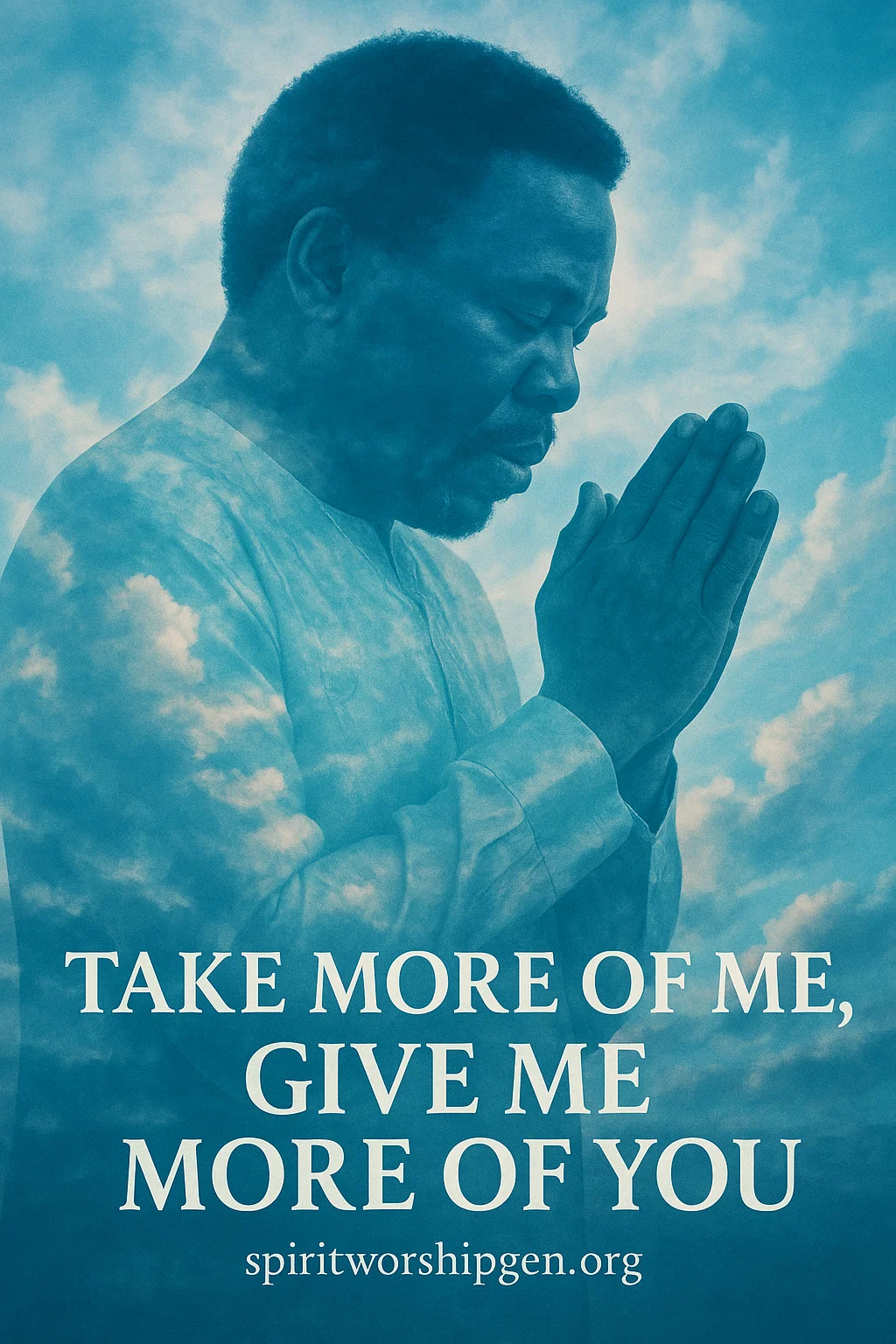
🌿 Take More of Me, Give Me More of You: The Prayer the Devil Cannot Pray
“But the tax collector stood at a distance. He would not even look up to heaven, but beat his breast and said, ‘God, have mercy on me, a sinner.’ I tell you that this man, rather than the other, went home justified before God.” — Luke 18:13-14
Two men went up to the temple to pray, and only one of them went home forgiven. The difference was not the length of the prayer, the eloquence of the words, or the volume of the voice. It was what the prayer actually cost the man who prayed it. The Pharisee listed his credentials before God. The tax collector could not even lift his eyes. Scripture does not record his prayer as beautiful. It records it as true. Not every word spoken toward heaven carries the same weight in the Spirit, and if you have ever wondered why some prayers seem to part the heavens while others echo off the ceiling and fall back down, this is where the answer begins.
There is a prayer Prophet TB Joshua taught believers to carry into every encounter with God: “Lord, take more of me, give me more of You.” It sounds simple. It is not. It is a declaration the enemy of your soul cannot make, because it requires the one thing he has permanently refused: surrender.
On this page
- Not every word you pray carries the same weight
- “Forgive me”: the entry point into God’s presence
- “Take more of me, give me more of You”: a declaration hell cannot copy
- Why the devil cannot pray this prayer
- Biblical heroes who prayed the prayer of surrender
- Are you saying “Amen” to what you don’t believe?
- Two prayers, two outcomes
- Practical application: how to pray the prayer heaven answers
- Prayer
🗣️ Not Every Word You Pray Carries the Same Weight
We have all said it: “Amen.” It means “so be it,” a word of agreement. But agreement is not the same as belief, and repetition is not the same as revelation.
“These people honor me with their lips, but their hearts are far from me.” — Matthew 15:8
Jesus said this about people who were technically religious, technically correct in their words, and completely absent in their hearts. That is a sobering warning for anyone who has ever prayed the right words without meaning a single one of them. You can quote scripture accurately and still be far from the God you are quoting. You can raise your hands and close your eyes and still never leave your own agenda.
Prophet TB Joshua taught something that exposes this danger directly:
“Those who would come to God must do so with humility and sincerity of mind and not confession in the form of fasting and praying or waving hands in worship without a thorough reformation of heart and life.” — Prophet TB Joshua
Notice what he did not condemn. He did not condemn fasting, praying, or worship. He condemned the version of those things that changes nothing in the heart. A prayer without reformation is a performance staged for other people, or even for your own conscience. A prayer with reformation is a transaction with heaven. The difference is not the vocabulary you use. It is whether the words are actually rearranging something inside you as you speak them, or simply passing through your mouth on their way to nowhere.
This is why two people can kneel at the same altar, say the same words, and leave in entirely different spiritual conditions. One left having only performed. The other left having actually met with God.
🙇 “Forgive Me”: The Entry Point Into God’s Presence
Before the tax collector asked God for anything, he asked God to forgive him. That order matters. He did not begin with a request. He began with a confession, and Jesus made sure His listeners understood that this, and not the Pharisee’s résumé, was what opened heaven that day.
“Forgive us our sins, for we also forgive everyone who sins against us.” — Luke 11:4
“The sacrifices of God are a broken spirit; a broken and contrite heart, O God, You will not despise.” — Psalm 51:17
David wrote those words after his sin with Bathsheba had been exposed, at the lowest point of his reputation, and yet this is the psalm the church has quoted for centuries as a model of restored intimacy with God. He did not offer God an explanation. He offered God a broken heart. Prophet TB Joshua taught why this posture opens what pride keeps permanently shut:
“Forgiveness is a bridge to where God dwells. Correction carries us to that place. It is a place of good success, a place of peace and comfort.” — Prophet TB Joshua
If forgiveness is a bridge, then “forgive me” is the first step onto it. You cannot ask God to take more of you while you are still defending yourself. You cannot ask Him for more of His Spirit while you are guarding territory in your heart He has not been invited into. Every real encounter with God begins the same way it began for the tax collector and for David: low, honest, and unguarded. Not loud. Not eloquent. True.
🔥 “Take More of Me, Give Me More of You”: A Declaration Hell Cannot Copy
This is not a phrase to recite. It is a transaction to mean.
When you pray “take more of me,” you are surrendering specific things, not abstract ones:
- Your pride, the part of you that needs to be right
- Your control, the part of you that needs to manage every outcome
- Your personal agenda, the plans you already decided were non-negotiable
- Your selfish ambition, the version of success that has nothing to do with obedience
When you follow it with “give me more of You,” you are asking for equally specific things in return:
- To be filled with the Holy Spirit, not your own strength
- To have your weakness overcome by His power, not hidden by your performance
- To have His will done, not yours, even when His will costs you something
- To be transformed from the inside out, not merely improved on the outside
Paul described what this looks like once it becomes a lifestyle rather than a phrase said once at an altar call:
“I have been crucified with Christ and I no longer live, but Christ lives in me. The life I now live in the body, I live by faith in the Son of God, who loved me and gave himself for me.” — Galatians 2:20
That is what “take more of me, give me more of You” is asking God to do. It is asking to be crucified in the places that resist Him and filled in the places that are empty. Hell has a counterfeit for eloquence, a counterfeit for volume, and a counterfeit for religious performance. It has no counterfeit for surrender, because there is nothing in hell’s nature capable of imitating it.
😈 Why the Devil Cannot Pray This Prayer
Look closely at how Scripture records Satan’s original fall, and notice something in the grammar itself.
“You said in your heart, ‘I will ascend to the heavens; I will raise my throne above the stars of God… I will make myself like the Most High.’” — Isaiah 14:13-14
Five statements, and every one of them begins with “I will.” Not “take more of me.” Not “give me more of You.” The very grammar of Satan’s fall is the opposite of surrender. He cannot say “take more of me” because there is nothing in him but self to take from, and surrendering it would dissolve the only thing he has left. He cannot say “give me more of You” because his entire rebellion was a refusal of God’s authority over him. Asking for more of God would mean admitting he needs what he tried to overthrow.
“God opposes the proud but shows favor to the humble.” — James 4:6
This is not a small technicality. It is the dividing line between the kingdom of darkness and the kingdom of God. Darkness operates by self-exaltation. Heaven operates by surrender. Every time you pray “take more of me, give me more of You” and mean it, you are speaking the one language your enemy is structurally incapable of speaking back at you. That is why Prophet TB Joshua called this a prayer hell cannot copy. It is not a stronger prayer because it is louder. It is a stronger prayer because it is spoken in a dialect the enemy has no mouth for.
🕊️ Biblical Heroes Who Prayed the Prayer of Surrender
Isaiah: Undone in the Presence of Glory
When Isaiah saw the Lord high and lifted up, his first words were not praise. They were a confession of his own condition.
“Woe to me! I am ruined! For I am a man of unclean lips, and I live among a people of unclean lips, and my eyes have seen the King, the Lord Almighty.” — Isaiah 6:5
Only after Isaiah surrendered his own righteousness did a seraphim touch his lips with a live coal and cleanse him. His commissioning as a prophet came directly after his undoing, not before it. Heaven did not send him with unclean lips. It sent him after he confessed them.
Peter: Sinking Before He Was Sent
After a miraculous catch of fish that defied every fisherman’s experience on that boat, Peter’s response was not excitement. It was terror at his own unworthiness in the presence of that much power.
“Go away from me, Lord; I am a sinful man!” — Luke 5:8
Jesus did not go away from him. He called him instead. Peter’s confession of his own inadequacy became the doorway into becoming a fisher of men, not a disqualification from it.
Paul: Blinded Into Clarity
On the road to Damascus, Saul of Tarsus was struck down by a light brighter than the sun, and the first words out of the most religiously accomplished man of his generation were a surrender of his entire agenda.
“Lord, what do you want me to do?” — Acts 9:6 (KJV)
He did not negotiate. He did not defend his credentials, though he had many worth defending by human standards. He asked what God wanted, and he spent the rest of his life doing exactly that, at the cost of every position of respect he had once held.
Mary: Surrender Before Understanding
When the angel Gabriel told a young, unmarried woman that she would carry the Son of God, Mary’s response did not ask for guarantees or explanations.
“I am the Lord’s servant. May it be to me according to your word.” — Luke 1:38
She surrendered to a plan she could not fully understand, at a cost to her own reputation she could not fully calculate in that moment. That surrender carried the Messiah into the world.
Job: Repentance After Restoration of Sight
After chapters of arguing his case before God, demanding an audience and an explanation, Job’s posture changed completely the moment he actually encountered the Lord rather than merely hearing about Him.
“My ears had heard of you but now my eyes have seen you. Therefore I despise myself and repent in dust and ashes.” — Job 42:5-6
Every one of these five had a different story, a different failure, a different calling on their life. But every one of them arrived at the same posture before God moved further with them: undone, low, and surrendered. None of them stayed in that posture of terror or grief. Surrender was always the doorway, never the destination.
🎭 Are You Saying “Amen” to What You Don’t Believe?
Paul asked a pointed question about worship that carries no revelation behind it:
“If you are praising God in the Spirit, how can someone else, who is now put in the position of an inquirer, say ‘Amen’ to your thanksgiving, since they do not know what you are saying?” — 1 Corinthians 14:16
Now put a different kind of inquirer into that verse: your own heart. How many times have you said “Amen” to a prayer your own heart did not actually agree with? Out of habit, not hunger. Out of routine, not relationship. Out of reflex, not revelation. This is the spirit of religion, and it is comfortable in every church, because an empty “Amen” costs nothing and changes nothing in the person who says it.
Prophet TB Joshua drew a sharp line between that kind of prayer and the kind that actually accomplishes something in the Spirit:
“Scriptural prayer releases God’s power to heal, deliver, bless and save.” — Prophet TB Joshua
Notice the word “releases.” Power that is already available does not move until the right prayer is prayed. Not the loudest prayer. Not the longest prayer. The scriptural one, the surrendered one, the one that means what it says when it says it. When you say “Lord, take more of me, give me more of You” and actually mean it, you are not performing spiritual autopilot. You are waking your spirit up, and you are speaking words the enemy has no defense against.
📊 Two Prayers, Two Outcomes
| The Surface Prayer | The Surrendered Prayer | |
|---|---|---|
| Posture | Defends itself | Confesses itself |
| Starting point | What I want from God | What God wants to remove from me |
| Example | The Pharisee listing his credentials | The tax collector beating his chest |
| Effect on pride | Left untouched | Directly surrendered |
| What hell can imitate | The words, the volume, the routine | Nothing |
| Outcome (Luke 18:14) | Not justified | “Went home justified before God” |
✅ Practical Application: How to Pray the Prayer Heaven Answers
- Begin with thanksgiving, not petition. Before you ask God for anything, thank Him for what He has already done. Gratitude positions the heart before requests reposition the circumstances.
- Say “forgive me” before you say anything else. Do not wait until you feel guilty enough to mention it. Make confession the doorway you walk through into every prayer, the way the tax collector did before he asked for a single thing.
- Name what you are actually surrendering. Do not say “take more of me” in the abstract. Name the pride, the control, the agenda, or the ambition you are handing over that day, specifically, out loud if you need to.
- Ask specifically for what you actually need from God. “Give me more of You” should be followed by specifics: more of His Spirit in a weak area, more of His wisdom over a decision, more of His strength in a battle you already know you are losing on your own.
- Slow down enough to mean your own words. If you cannot slow down enough to feel the weight of “take more of me,” you are reciting a phrase instead of praying a prayer, and the enemy is not threatened by phrases.
- Let your “Amen” be tested by your life afterward. An “Amen” that changes nothing about how you live the rest of your day was likely never a real agreement with heaven in the first place. Real surrender always shows up somewhere by evening.
🙏 Prayer
Lord, take more of me. Take my pride, my need to control, my hidden agendas, and my selfish ambition. Give me more of You. Fill me with Your Spirit where I am weak. Let Your will be done in my life, not mine. Forgive me before I ask You for anything else, and teach me not just to say “Amen” but to live in agreement with heaven. Keep me humble, broken, and useful for Your glory, the way You kept Isaiah, Peter, Paul, Mary, and Job when they stood undone before You. In Jesus’ name, Amen.
Good Morning 🌄 and PROSPER ✨ today!
Let this blog stir your spirit. Share it with someone who needs to hear this today, and continue your walk with God in deeper intimacy at www.spiritworshipgen.org.
Please like, follow and subscribe to our social media channels:
Facebook: Generation of Spiritual Worshippers - GOSW
YouTube: @spiritworshipgen
X (Former Twitter): @gensworshipper
Instagram: @spiritworshipgen
TikTok: @spiritworshipgen
Related Teachings




References
[Facebook post link — add after publishing]
Published by SpiritWorshipGen – A Generation of Spiritual Worshippers
Comments
This discussion is closed for new comments.