Why God Calls People Who Are Already Busy Working
🌿 Why God Calls People Who Are Already Busy Working
“But the LORD called me away from my flock and told me, ‘Go and prophesy to my people in Israel.’” — Amos 7:15 (NLT)
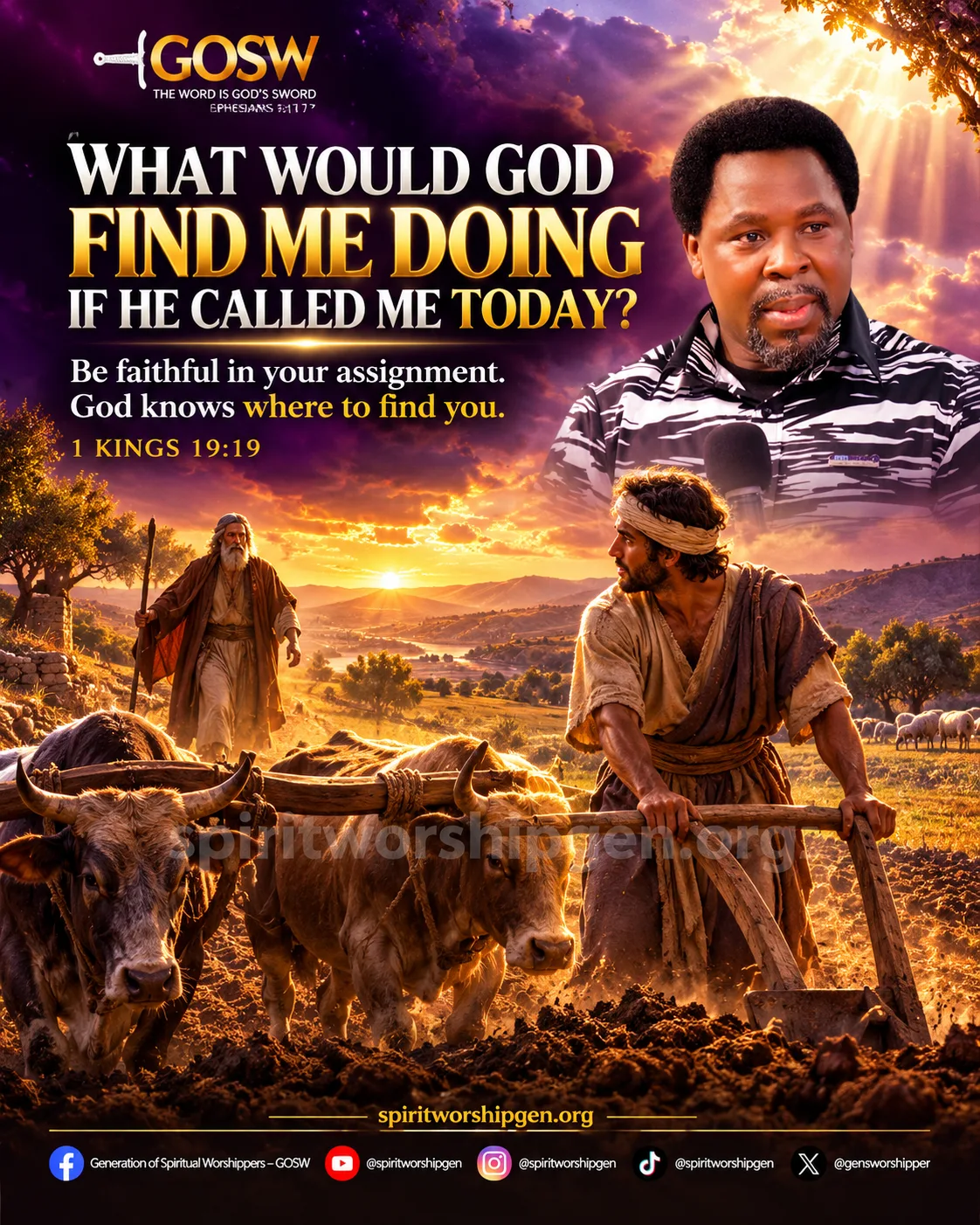
When God decides to choose someone to carry out His master plan, what will He find you doing? Amos was a shepherd. Elisha was behind a plow. David was out with the sheep. None of them was sitting still, waiting for a call, and none of them was in a pulpit or a prayer line. God found each of them busy, and He called each of them away from something they were already doing faithfully.
On this page
- God calls you away from something
- Elisha was found behind the plow
- David was busy in the pasture
- More who were found working
- God is looking for stakeholders, not spectators
- Nobody is qualified, so God teaches them Himself
- Cornelius: the call came to a praying soldier
- Be teachable, be diligent, be faithful
- Practical application: what will He find you doing?
- Prayer
🐑 God Calls You Away From Something
Read the whole exchange in Amos 7. A priest named Amaziah told Amos to go home and prophesy somewhere else, and Amos did not defend himself with a résumé. He gave the plainest answer in the Bible:
“I’m not a professional prophet, and I was never trained to be one. I’m just a shepherd, and I take care of sycamore-fig trees. But the LORD called me away from my flock and told me, ‘Go and prophesy to my people in Israel.’” — Amos 7:14-15 (NLT)
Look at the shape of that sentence. I’m just a shepherd. I take care of sycamore-fig trees. The LORD called me away from my flock. Amos did not receive his call while he was idle. He received it while he was working, and God pulled him out of that work and sent him into a new one. A call from God is almost always a call away from something.
Sycamore-fig trees were not a glamorous crop. The fruit was cheap, and the work of tending it meant nicking each fig so that it would ripen. It was patient, repetitive, unseen work. Yet that is the kind of work God looked at when He went looking for a prophet to confront a nation. He did not search the schools of the prophets. He walked into the pasture.
When God calls you, He calls you away from something you are already doing.
That sentence should change how you look at your Monday morning. The job you are tempted to despise, the shop you open every day, the class you study for, the family you raise, the field you plow: these are not delays between you and your calling. They are the place where the call will find you.
🌾 Elisha Was Found Behind the Plow
Elijah had been told by God to anoint Elisha as his successor. Notice how God arranged the meeting:
“So Elijah went and found Elisha son of Shaphat plowing a field. There were twelve teams of oxen in the field, and Elisha was driving the twelfth team. Elijah went over to him and threw his cloak across his shoulders and then walked away.” — 1 Kings 19:19 (NLT)
Elijah found him. That word matters. God sent a prophet to a particular field, and the one who was sent found a particular man working. Elisha was not at a conference, not at the temple, not asking for a ministry. He was driving the twelfth team of oxen, which means he was at the back of the line, under the eyes of eleven others who were ahead of him. If Elisha had been lazy, the whole row would have been delayed. He was in a place where his diligence was visible to everybody around him.
Then Elijah threw his cloak over him and kept walking. No sermon, no explanation. Elisha understood at once what had happened.
“Elisha left the oxen standing there, ran after Elijah and said to him, ‘First let me go and kiss my father and mother goodbye, and then I will go with you!’” — 1 Kings 19:20 (NLT)
What he did next is the part many people skip:
“Elisha then returned to his oxen and slaughtered them. He used the wooden plow as fuel to cook the meat, and he passed around the meat to the townspeople, and they all ate. Then he went with Elijah as his assistant.” — 1 Kings 19:21 (NLT)
Elisha burned the plow. He fed his neighbors with the oxen. He closed the door behind him so thoroughly that there was no field left to run back to. That is what happens to a man who has been faithful in his work: he leaves it with honor, not with resentment, and he leaves it with a testimony in the town. The people who watched him plow all those years ate the meal of his farewell. Even his departure blessed the people around him.
A lazy man would have a hard time leaving cleanly. A faithful man leaves behind a place that is better because he worked there.
🎶 David Was Busy in the Pasture
When the prophet Samuel came to Jesse’s house to anoint a king, Jesse paraded seven sons in front of him and God refused all seven. Samuel asked if there were any more.
“There is still the youngest,” Jesse replied. “But he’s out in the pasture watching the sheep and goats.” — 1 Samuel 16:11 (NLT)
Think about what that tells us. The prophet of God was in the house. The sacrifice was prepared. The whole family was waiting. And David was not there, because somebody had to watch the sheep, and the job fell to the youngest. Nobody thought of it as a position of promise. It was the job nobody else wanted.
“So Jesse sent for him… And the LORD said, ‘This is the one; anoint him.’ So as David stood among his brothers, Samuel took the olive oil he had brought and anointed him. And the Spirit of the LORD came powerfully upon David from that day on.” — 1 Samuel 16:12-13 (NLT)
David did not leave the pasture to find his destiny. His destiny came and found him in the pasture. And what was he doing there? Years later he told King Saul what that pasture had taught him:
“I have been taking care of my father’s sheep and goats. When a lion or a bear comes to steal a lamb from the flock, I go after it with a club and rescue the lamb from its mouth.” — 1 Samuel 17:34-35 (NLT)
Before David ever faced Goliath, he faced a lion and a bear with no audience. He guarded sheep as if every lamb were his own life. That is why a king could later say of him, “I have found David son of Jesse, a man after my own heart” (Acts 13:22). The pasture was the training ground, and the shepherd’s staff was the first sceptre he ever held.
If you want to read more about the long road between David’s anointing and his throne, True Anointing Takes Time and Preparation walks through the years of hiding, running and waiting that followed the oil.
🔨 More Who Were Found Working
The pattern is not limited to three men. It runs through the whole Bible. God keeps meeting people in the middle of ordinary labor:
- Moses was tending his father-in-law’s flock when he came to the mountain of God and saw the burning bush (Exodus 3:1). After forty years in the wilderness behind sheep, he was still faithfully doing the assigned work when heaven interrupted.
- Gideon was threshing wheat in a winepress, hiding the grain from the Midianites, when the angel of the LORD greeted him as a mighty hero (Judges 6:11-12). He was working in fear, yet he was still working, and God called him by what he would become.
- Peter, Andrew, James and John were fishermen washing their nets when Jesus said, “Follow me, and I will show you how to fish for people” (Matthew 4:18-20, NLT). They were in the middle of their trade, and they left it to follow Him.
- Matthew was sitting at his tax booth when Jesus said, “Follow me,” and he got up and followed Him (Matthew 9:9).
Not one of them was waiting for a vision on a quiet hilltop. Every one of them was occupied. And when you read the list slowly, you notice something else: none of them was working at a high-profile job. A shepherd, a farmhand, a fisherman, a tax collector, a man threshing wheat in secret. God did not choose from the places the world admires. He chose from the places the world ignores, and He chose people who were faithful where they stood.
Prophet TB Joshua taught that the small things carry great weight:
“Faith is manifested in the small things in our daily life.” — Prophet TB Joshua
If faith shows itself in small things, then your small things are not small to God. They are where He checks whether you can be trusted with something large.
🔥 God Is Looking for Stakeholders, Not Spectators
God has a master plan for His creation. He is not drifting or improvising, and He is looking for people to execute His projects. In every generation He needs men and women who will own a piece of the work and carry it through, not merely admire it from a distance. Think of them as stakeholders: people who have something at stake and who take responsibility for the outcome.
What He finds you doing matters to that plan, because a person who is not carrying responsibility today cannot be handed responsibility tomorrow. A man who leaves the sheep unguarded will not be given the nation. A woman who is careless with a small account will not be given an empire. Jesus laid down the principle plainly:
“If you are faithful in little things, you will be faithful in large ones. But if you are dishonest in little things, you won’t be honest with greater responsibilities.” — Luke 16:10 (NLT)
And in the parable of the talents, the master’s answer to the servant who handled a little well was this:
“Well done, my good and faithful servant. You have been faithful in handling this small amount, so now I will give you many more responsibilities. Let’s celebrate together!” — Matthew 25:21 (NLT)
Faithful in handling this small amount. That is the phrase God remembers. He wants to raise men who will make a difference in their world, and men who will do what no one has done before. But He raises them from among those who are diligent and busy, not from among those who are drifting.
The same wisdom runs through Proverbs:
“Do you see any truly competent workers? They will serve kings rather than ordinary people.” — Proverbs 22:29 (NLT)
God notices diligence. He promotes it. Prophet TB Joshua said it in one blunt sentence:
“The person that folds his hands will not have any record.” — Prophet TB Joshua
A person with folded hands leaves no record, because there is nothing to write. A person who is working leaves a trail that heaven can read.
So here is the word for you today. No matter where you are in life, get busy. Take delight in the little thing you are doing. Do it diligently and in the fear of God. One day God will find you, and He will call you away from your work into His own work. Until then, let Him find you working.
🎓 Nobody Is Qualified, So God Teaches Them Himself
Here is something that should free every doubtful heart. Amos said, “I was never trained to be a prophet.” Elisha was a farmer. David was a boy with a sling. None of them had a qualification the world would recognize, and God was not troubled by it. Why? Because in the kingdom of God, nobody is an expert or a professional. No one arrives with a degree in what God is about to ask of them.
Just as a good employer places the right person in the right position, God appoints suitable men and women to His work. But He alone sets the standard for what makes someone suitable. No one merits the call. It is not a prize for the most talented, the best-educated or the loudest. Prophet TB Joshua said:
“The fact that you can preach, teach, have eloquent speech and the ability to inspire people or quote the Bible from Genesis to Revelation does not mean that you are suitable for God.” — Prophet TB Joshua
If gifting and eloquence do not make you suitable, then what does? He answered that too: “To be suitable, you must honour Jesus with your character.” That is the exact thing God was looking at in the field and in the pasture. If you want to go deeper into that truth, read Why God Values Your Character More Than Your Spiritual Gifts.
When God calls you without training, He does not leave you untrained. He teaches you Himself. Prophet TB Joshua testified of this in his own life. He spoke and wrote in tongues by the help of the Holy Spirit, a language he had never learned, and he said plainly:
“The Holy Spirit will speak through us in a language we have not learned.” — Prophet TB Joshua
No school taught him that language. It was divinely inspired and taught by God Himself. If you want to know more about that gift, When Heaven Writes: The Untold Gift of Prophet TB Joshua tells the story.
Jesus promised the same teacher to every believer: “The Holy Spirit, whom the Father will send in my name, will teach you everything and will remind you of everything I have told you” (John 14:26, NLT). The classroom is the Spirit, and the course is your obedience.
🪖 Cornelius: The Call Came to a Praying Soldier
If Amos, Elisha and David feel too far away, look at Cornelius. He lived in the first century, in the Roman army, and he was not even Jewish.
“At Caesarea there lived a Roman army officer named Cornelius, who was a captain of the Italian Regiment. He was a devout, God-fearing man, as was everyone in his household. He gave generously to the poor and prayed regularly to God.” — Acts 10:1-2 (NLT)
Hold that picture in your mind. Cornelius held a demanding job, led a household, gave to the poor and prayed regularly. Nobody in the church knew him. He had no mentor in the faith and no public ministry. Then one afternoon an angel appeared to him:
“Your prayers and gifts to the poor have come up as a memorial offering before God.” — Acts 10:4 (NLT)
Heaven had been keeping records of what he did in private. He was told to send for Peter, and Peter came. In the same way that God sent Elijah to find Elisha in the field, God sent Peter to find Cornelius in his house. While Peter was still speaking, “the Holy Spirit fell on all who were listening to the message” (Acts 10:44), and afterward Cornelius and his household were baptized in water.
Scripture does not give us more detail about the rest of his life. I believe the same Holy Spirit who fell on him in that room continued to lead him into whatever God had planned for his life. A man who had been so faithful before the call would not be careless after it.
Notice carefully what moved heaven. It was not his rank, and it was not his army. It was how he lived: devout, God-fearing, generous, prayerful. What Cornelius did was admirable to men. The way he did it, with reverence and sincerity, got the attention of God. That brings us to a truth worth underlining.
What you do can attract men, but the way and manner you do it can attract God.
🧭 Be Teachable, Be Diligent, Be Faithful
If God teaches the people He calls, then the question is whether you can be taught. Here is what God looks for in the season before the call:
Teachability
Elisha asked to say goodbye to his parents, but he did not argue with the prophet or demand proof. He followed and served as Elijah’s assistant, and the man who would later carry a double portion of the Spirit began by pouring water on his master’s hands (2 Kings 3:11). A teachable person is willing to start at the bottom. If you cannot take instruction from the person God placed in front of you, you will not take it from heaven.
Obedience
Samuel’s whole mission to Jesse’s house depended on obeying a command that made no sense. Cornelius obeyed the angel the moment he was told. When God speaks, the answer is not “let me think about it.” Obedience in the small instructions prepares you for obedience in the large ones.
Character
Your work ethic, your honesty, your temper, your integrity when nobody is watching: God sees all of it. Prophet TB Joshua said:
“Only your character can testify to the genuineness of your confession of Christ.” — Prophet TB Joshua
You may say you love God, but your character in the field is the witness the angels will quote.
Hard Work
“Whatever you do, work at it with all your heart, as working for the Lord, not for human masters” (Colossians 3:23, NLT). That verse is addressed to ordinary working people, and it turns every job into an altar. When you do your work as to the Lord, you are already in His service, and the work of God is only a step further along the same road.
Here is the encouraging side of this. When you decide on a direction and set your feet on it, God supplies the strength for the distance. The Scriptures describe the principle again and again: “Those who trust in the LORD will find new strength. They will soar high on wings like eagles. They will run and not grow weary. They will walk and not faint” (Isaiah 40:31, NLT). God does not hand out energy to people who have not yet started walking. When you decide to move in the right direction, He joins you with strength you did not know you had.
Prophet TB Joshua summed it up with a promise that every one of us can test:
“If you follow the direction of your calling, you will surprise yourself; you will make a difference in your world.” — Prophet TB Joshua
Everyone has a calling. Not only prophets and preachers, but also the teacher, the nurse, the farmer, the engineer, the mother, the student. You will surprise yourself when you stop looking sideways at someone else’s assignment and start following the direction God has set for you.
✅ Practical Application: What Will He Find You Doing?
If a call can come at any hour, how should you live while you wait? Here is a simple plan.
- Stop calling your present work small. Amos was “just a shepherd.” You may be “just” a clerk or “just” a student. Redefine the word. It is the field where God is currently watching you.
- Do it as unto the Lord. Show up on time. Finish what you started. Refuse shortcuts. Give an honest day’s work, because Colossians 3:23 makes your employer secondary and God primary.
- Take delight in it. Do not drag yourself through the job with resentment. Gratitude is a form of worship, and people who enjoy the work they have are people who can be trusted with more.
- Keep a prayer life that does not depend on circumstances. Cornelius prayed regularly. The call found him on his knees, not on his phone.
- Be generous where you are. Cornelius gave to the poor. Whatever is in your hands now can help someone, and Prophet TB Joshua said that “Whatever is in your hands now is a solution to someone else in need.”
- Stay teachable. Accept correction from the people God has placed over you. Ask questions. Take notes. Do not argue with every instruction.
- Guard your integrity when nobody is watching. David fought the lion and the bear in a pasture with no audience. Private faithfulness is the foundation for public assignment.
- Be ready to leave. Elisha did not cling to the plow. When the call comes, loosen your grip on what you have built, thank the people who worked beside you, and walk forward with a clean record.
- Be patient with the timing. David was anointed as a teenager and crowned many years later. Keep working in the in-between.
Here is a simple comparison to keep in mind:
| Waiting for a call | Working until the call |
|---|---|
| Sits idle, hoping for a sign | Stays diligent in what is in hand |
| Despises the current job as beneath a “real” calling | Treats the current job as the field God is watching |
| Wants the platform first | Wants the character first |
| Expects to be trained by men before starting | Stays teachable, knowing God Himself trains |
| Is distracted by someone else’s assignment | Follows the direction of their own calling |
| Is unprepared when the cloak is thrown | Is ready to leave the plow behind |
Ask yourself honestly which column describes your life this week. If it is the first one, the answer is not to despair. It is to begin. Open the shop. Pick up the plow. Take care of the sheep. Do the next thing in front of you with all your heart, because heaven keeps watching and heaven keeps records.
What God finds you doing matters.
🙏 Prayer
Father, thank You that You call people who are faithful in the ordinary. Forgive me for the times I have despised my present work and the days I have wasted waiting for something grand. Teach me to labor with all my heart, as unto You. Make me diligent like Elisha, faithful like David, humble like Amos and devout like Cornelius. Give me a teachable spirit, build my character in secret, and when You are ready to call me, let me be found busy in the work You have given me today. I will follow the direction of my calling, and I trust You for the strength to go the distance. In Jesus’ name, Amen.
Good Morning 🌄 and PROSPER ✨ today!
Let this blog stir your spirit. Share it with someone who needs to hear this today, and continue your walk with God in deeper intimacy at www.spiritworshipgen.org.
Please like, follow and subscribe to our social media channels:
Facebook: Generation of Spiritual Worshippers - GOSW
YouTube: @spiritworshipgen
X (Former Twitter): @gensworshipper
Instagram: @spiritworshipgen
TikTok: @spiritworshipgen
Related Teachings




References
[Facebook post link — add after publishing]
Published by SpiritWorshipGen – A Generation of Spiritual Worshippers
Comments
This discussion is closed for new comments.